

The floor that looks best in a sample may not be the right choice for the room. If you’re asking, “should I choose sheet vinyl or LVT?”, consider how the space is used, the finish you want and the condition of the existing floor. Each of these can affect which product and fitting approach are suitable.
Both options come in a wide range of designs and can suit busy homes, but they’re made and fitted differently. Comparing samples in your own space helps you judge colour, pattern and texture in the light the room actually gets. It’s also worth checking the manufacturer’s guidance before comparing products, as specifications can vary between ranges.
This practical 2026 comparison explains how sheet vinyl and LVT differ in appearance, everyday use, care and fitting. It also looks at which format may suit different rooms and why the subfloor matters. By the end, you’ll have a clearer basis for comparing options and useful questions to ask a flooring professional before arranging a supply-and-fit service.
Key Takeaways
- Sheet vinyl comes in a continuous sheet, while LVT uses individual tiles or planks. The format affects the floor’s appearance and how it is fitted.
- Wondering “should I choose sheet vinyl or LVT”? Compare the room’s layout, your preferred finish and how the space is used before deciding.
- Check each product’s guidance for durability, water resistance and upkeep. Don’t assume every product in either format performs the same way.
- View samples in the room and ask for the subfloor to be assessed. An uneven or unsuitable surface may need preparation before fitting.
- GW Flooring is a family-run business based in Rayleigh, Essex, with over 20 years of experience supplying and fitting vinyl and LVT.
Sheet vinyl or LVT: what is the difference between the two?
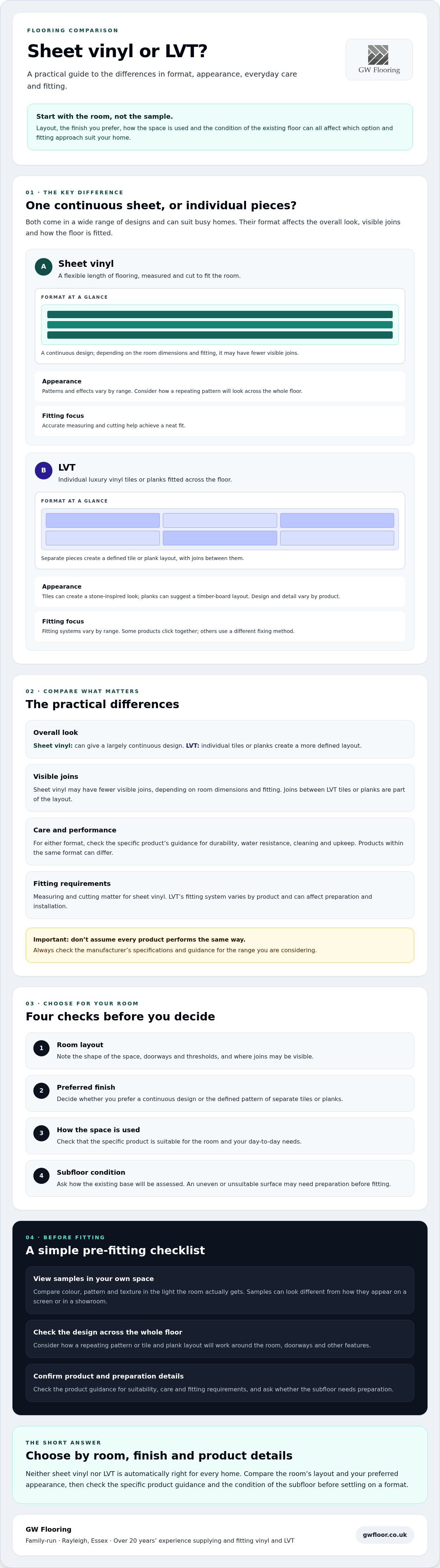
Neither format is automatically right for every home or room. If you’re asking, “should I choose sheet vinyl or LVT?”, begin with how each is made: sheet vinyl is supplied as a continuous sheet, while LVT consists of individual tiles or planks. This affects the floor’s overall look, the number and position of visible joins, and the fitting method.
What is sheet vinyl flooring?
Sheet vinyl is a flexible length of flooring cut to fit the room. Depending on the room’s dimensions and the fitting, it may have fewer visible joins than a floor made from separate pieces, creating a more continuous appearance. Its designs, wear layers and recommended uses vary by range, so check the product guidance rather than assuming all sheet vinyl has the same performance. When comparing samples, consider how a repeating pattern will look across the full floor, not just in a small section.
What is LVT flooring?
LVT consists of individual luxury vinyl tiles or planks fitted across the floor. Tiles can create a stone-inspired look, while planks can suggest a timber-board layout. The available designs and fitting systems depend on the range. For background on the category, see this overview of Luxury Vinyl Tile (LVT). Check the specifications for the product you’re considering, including how it is fitted and what preparation it requires.
The format is only one part of the decision. Some LVT products are designed to click together, while others use a different fixing method. Sheet vinyl needs accurate measuring and cutting for a neat fit. Room shape, doorways and thresholds can influence the fitting approach for either format. In both cases, check that the subfloor is suitable: an uneven or otherwise unsuitable base may affect the finished appearance and need preparation before fitting.
As you compare options, consider:
- Room and layout: Note the shape of the space, doorways and thresholds, and where joins may be visible.
- Appearance: Decide whether you prefer a continuous design or the defined pattern of separate tiles or planks.
- Product guidance: Check the specific range’s suitability, care instructions and fitting requirements.
- Subfloor condition: Ask how the existing base will be assessed and whether preparation may be needed.
These checks are more useful than choosing by a sample or format name alone. Next, compare how the two options may fit your day-to-day needs, including their appearance, care and installation requirements.
How do sheet vinyl and LVT compare in everyday use?
Both formats can be practical, but what you can expect depends on the particular product and how it is fitted. Use this table as a starting point, then check the manufacturer’s guidance for the range and the conditions in your room.
| Consideration | Sheet vinyl | LVT |
|---|---|---|
| Format | A continuous sheet, cut to fit the space. | Individual tiles or planks fitted across the floor. |
| Design options | Patterns and effects vary by range, often creating a continuous overall design. | Tile and plank layouts offer different ways to arrange the floor. |
| Visible joins | May have fewer visible joins, depending on room dimensions and fitting. | Joins between tiles or planks are part of the layout. |
| Upkeep | Follow the product’s cleaning and care instructions. | Follow the product’s cleaning and care instructions. |
| Fitting | Accurate measuring and cutting help achieve a neat fit. | The fitting system varies by product and may affect preparation and installation. |
Which format offers more design flexibility?
Sheet vinyl can carry a pattern or effect across the floor as a largely continuous design. LVT’s individual planks and tiles can be arranged in different layouts, including wood- or stone-inspired effects. Neither format is always more realistic: finish and detail vary between products. Look at actual samples in your home’s lighting, because colour and texture can appear different from how they look on a screen or in a showroom. If you’re choosing a patterned design, consider how it will look across the whole room and around doorways or other features.
Which floor is easier to maintain and live with?
Routine care depends on the product, so check its instructions before choosing cleaning products or methods. Don’t assume every vinyl floor has the same resistance to water, wear or marks. These qualities, along with suitability for a particular room, depend on the product specification and installation. For wider industry background on resilient flooring, the Resilient Floor Covering Institute is a useful reference.
For kitchens, hallways and living spaces, weigh the room’s everyday use against the product’s wear, cleaning and room-suitability guidance. Foot traffic, seams and fitting details may also affect the result. Ask how the recommended product is suited to the specific space rather than relying on the room name alone. The question “should I choose sheet vinyl or LVT?” is best answered by comparing suitable products, not by assuming one format always performs better.
Seeing samples at home makes it easier to judge colour and pattern in context. Explore GW Flooring’s vinyl and LVT service and sample options as part of your comparison.
Which should you choose: sheet vinyl or LVT for your room?
Start with the room, not a general claim that one format is better. Consider its shape, how the household uses it, the look you want and the chosen product’s guidance. A kitchen with a large visible floor area, a narrow hallway and an open living space may each call for a different balance of pattern, joins and fitting requirements.
Ask yourself:
- Would a continuous pattern or individual tiles or planks suit the room’s proportions?
- How much foot traffic and day-to-day activity does the floor need to accommodate?
- What does the product guidance say about room suitability, care and installation?
These questions turn “should I choose sheet vinyl or LVT?” into a comparison between products that may suit your room, rather than a decision based on format alone.
When might sheet vinyl suit your priorities?
If you prefer a continuous appearance, sheet vinyl may be worth considering. Think about the room’s dimensions and layout, as cuts and joins can depend on the space and fitting. A pattern that looks appealing in a small sample may feel different across a larger floor, so view it in context. Check the chosen product’s guidance for intended use and fitting needs. A continuous sheet alone doesn’t guarantee better performance or less upkeep.
When might LVT suit your priorities?
LVT may appeal if individual planks or tiles suit the design you have in mind, such as a particular direction or arrangement. Compare the construction and fitting requirements of specific products before choosing, as these can differ between ranges. For more on the fitting process, read this professional LVT flooring installation guide.
For kitchens, hallways and living spaces, match the product guidance to the room’s use rather than relying on the room name alone. Bathroom flooring also needs careful consideration of product suitability and installation, so consult a dedicated bathroom flooring comparison before deciding.
Samples help make the choice more concrete. View them in the room where the floor will be fitted and check them in the light you live with. GW Flooring’s showroom-to-you service can bring samples to your home or business, making it easier to compare colour and finish against your lighting and décor.
What should you check before choosing sheet vinyl or LVT?
Before settling on a design, check that the product and fitting approach suit the room as it is, not just how you hope it will look. Use this checklist to prepare for a practical conversation with a flooring professional:
- Room use: Describe the day-to-day activity in the space and check the product’s stated suitability.
- Measurements and layout: Note the room’s dimensions, shape, doorways and thresholds. Accurate measurements help inform product choice and fitting.
- Samples: Compare colour and finish in the room, in both natural and artificial light.
- Product guidance: Ask about the chosen range’s care instructions, installation requirements and suitability for your room.
- Subfloor assessment: Have the existing base checked before deciding what preparation, if any, is needed.
If you’re still weighing up “should I choose sheet vinyl or LVT?”, the subfloor is one practical factor that can help narrow down suitable options.
How does the subfloor affect your flooring choice?
A sound, suitably prepared base helps the new floor achieve its intended finish. Uneven or unsuitable areas may affect how the surface looks once fitted, so the subfloor should be assessed before work is planned. The right preparation depends on the condition of the existing floor and the chosen product’s requirements. Screeding or plyboarding may be options if an assessment indicates they’re needed, but neither should be assumed in advance. Ask a flooring professional to inspect the base before confirming your selection.
What should you ask before arranging a supply-and-fit service?
Clear questions help you understand what the job involves before fitting is arranged. Ask what preparation the room may need, what the fitting process includes and whether the selected product is suitable for the room’s conditions. Confirm how to care for the floor once it’s in place. You can also ask how measurements and room features will affect the final layout.
Take time to compare samples at home. Daylight and artificial lighting can change how a colour or finish appears, and seeing it alongside your walls and furnishings can make the decision clearer. For wider fitting considerations, read this professional floor installation guide.
GW Flooring supplies and fits vinyl and LVT, and provides subfloor preparation where required. Discuss your vinyl or LVT flooring requirements and the checks your room may need.
Choose sheet vinyl or LVT with confidence in Essex
The right choice comes from considering the format, the product’s specifications, how the room is used and whether the subfloor is ready for fitting. A sample can help you choose a colour or pattern, but the product guidance and condition of the base matter just as much to the finished result.
GW Flooring is a family-run flooring business based in Rayleigh, Essex, with over 20 years of experience supplying and fitting vinyl and LVT. Its showroom-to-you service brings samples to homes and businesses, so you can compare suitable options in the space where they’ll be installed.
How can local flooring advice help you decide?
A flooring professional can consider the room, existing subfloor and fitting requirements alongside the product guidance. This assessment can help establish whether preparation may be needed before choosing a suitable sheet vinyl or LVT option. It keeps the focus on the groundwork as well as the visible finish.
Viewing samples at home is a practical way to compare colour, pattern and surface finish against your décor. Natural and artificial light can change how a sample appears, so check it at different times if you can. For a wider look at flooring decisions, read the home flooring options guide.
What is the next step if you are still undecided?
Bring a few useful details to the conversation: room measurements, photographs and a note of how the space is used. You might also list what matters most, such as a continuous look, a particular plank or tile layout, or care instructions you’re comfortable following. Ask which options suit the room and what fitting and any required subfloor preparation involve.
If you’re still asking, “should I choose sheet vinyl or LVT?”, comparing samples alongside an assessment of the room can help turn uncertainty into a considered decision. Discuss the options, samples, preparation and fitting with GW Flooring.
Make your flooring choice with confidence
There’s no single right answer to “should I choose sheet vinyl or LVT?” Compare the format and appearance you prefer with the product’s specifications, the room’s everyday demands and the condition of the subfloor. The right preparation matters too: a suitable, well-prepared base helps the floor achieve its intended finish.
GW Flooring is a family-run business based in Rayleigh, Essex, with over 20 years of experience. Its showroom-to-you service brings samples to your home or business, so you can compare colours and finishes in the space itself. The team supplies and fits vinyl and LVT, with subfloor preparation available where needed.
Ready to discuss which options may suit your room? Discuss sheet vinyl and LVT options with GW Flooring. The product, room and subfloor checks can help you make an informed choice for your space.
Frequently Asked Questions
Is sheet vinyl better than LVT?
Neither is automatically better. The right choice depends on your room, preferred appearance and the specifications of the particular product. Sheet vinyl may appeal if you want a more continuous design, while LVT’s separate tiles or planks offer different layout possibilities. Compare care and installation guidance, and consider the condition of your subfloor. For an Essex home, focus on which product is suited to your space and household.
Is LVT more durable than sheet vinyl?
Not in every case. Durability depends on the product’s construction and wear specification, as well as how it is fitted and used. Compare the guidance for the specific ranges you’re considering, especially if the floor will see regular foot traffic or furniture movement. Ask how the product is intended to perform in your room, and follow the manufacturer’s cleaning and care instructions to maintain its finish.
Can sheet vinyl or LVT be used in a kitchen?
Either may be suitable for a kitchen if the specific product is recommended for that room and fitted according to its instructions. Don’t assume every vinyl floor has the same water resistance: product construction, joins and installation all matter. Check the manufacturer’s room-suitability guidance and care advice, and discuss how the kitchen is used. Spills and regular cleaning are practical considerations, but they don’t make every sheet vinyl or LVT product interchangeable.
Is sheet vinyl cheaper than LVT?
There isn’t a reliable answer based on format alone. The overall cost depends on the product selected and the work needed to fit it, including any subfloor preparation. Compare quotes for the same room and check what each includes, such as materials, fitting and preparation. A lower initial figure may not cover the same specification or work, so ask a flooring professional in Essex for the details before comparing options.
Does LVT need a perfectly level subfloor?
It needs a subfloor that meets the chosen product’s requirements, but exact tolerances vary by range and fitting system. Don’t assume an existing floor is suitable, or that it must be perfectly level, without an assessment. Uneven or unsuitable areas can affect the finished appearance and may require preparation. Ask a flooring professional to check the base and confirm what work, if any, is appropriate for your selected LVT.
Can I compare sheet vinyl and LVT samples at home?
Yes. Seeing samples in the room can help you judge colour, pattern and finish against your furnishings and lighting. GW Flooring, a family-run business based in Rayleigh, Essex, offers a showroom-to-you service that brings samples to customers’ homes or businesses. View them in both natural and artificial light if possible, then discuss which products suit the room and their fitting and subfloor requirements.


