

What if the biggest factor in a kitchen floor’s finished look isn’t the pattern you choose, but what lies beneath it? Spills, busy routines and an uneven subfloor are common concerns when choosing LVT for kitchens in Rayleigh. A good result depends on matching the flooring to the room and preparing the base properly.
LVT is a practical option for kitchens, with wood-, stone- and tile-inspired designs to suit different layouts and tastes. Format, finish and fitting all affect how the floor looks and performs day to day. This guide explains how to compare kitchen-ready options, why subfloor preparation matters and how to choose a design that complements your home.
GW Flooring is a family-run flooring business based in Rayleigh, with over 20 years of experience. We can bring samples to your home so you can see colours and finishes in your kitchen’s own light. We’ll also explain how preparation supports a neat installation. Here’s what to consider before choosing your new floor.
Key Takeaways
- Learn what LVT is made of and why product specifications matter when choosing a kitchen floor.
- Compare LVT with ceramic or porcelain tiles and sheet vinyl for everyday kitchen needs.
- See how wood- and stone-effect designs, plus plank or tile formats, can shape the feel of your kitchen. Find a style of LVT for kitchens in Rayleigh that suits your layout.
- Use a practical checklist to plan measurements, design choices, subfloor assessment and fitting.
- Discover how GW Flooring’s sample-to-home service and supply-and-fit process can help take your project from selection to installation.
Why choose LVT for a kitchen in Rayleigh?
A kitchen floor needs to complement your cabinets and worktops while standing up to cooking, foot traffic and the occasional spill. LVT, short for luxury vinyl tiles, comes in a wide range of wood- and stone-inspired designs for everyday rooms. If you’re comparing LVT for kitchens in Rayleigh, focus on matching the product specification and fitting method to how you use the space.
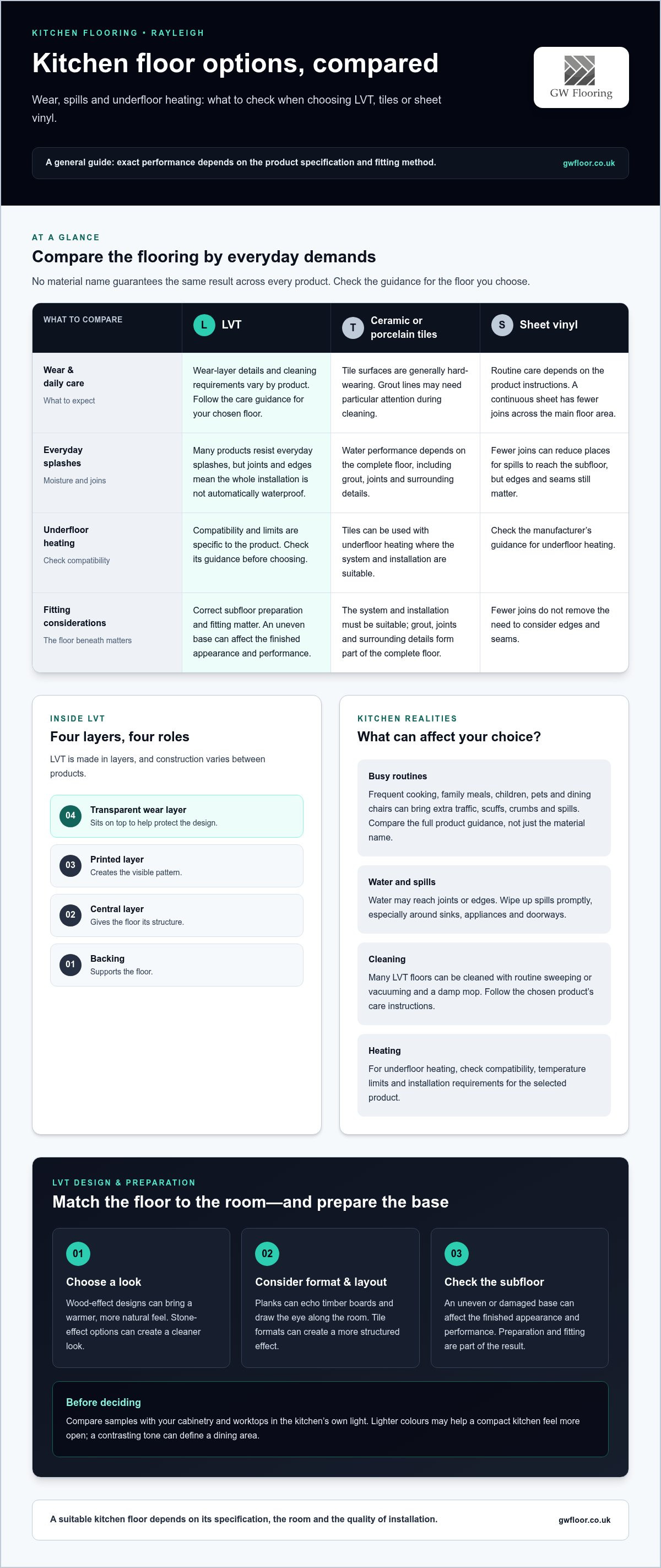
LVT is made in layers. A backing supports the floor, a central layer gives it structure, a printed layer creates the visible pattern, and a transparent wear layer sits on top to help protect the design. Construction varies between products, so don’t assume all LVT is the same. The Vinyl flooring overview gives more background on vinyl flooring and its different forms.
What makes LVT a practical kitchen flooring option?
Plank formats can echo timber boards, while tile formats can create a stone- or ceramic-inspired look. This flexibility makes it easier to coordinate the floor with both contemporary and traditional kitchens. Many LVT floors can be cleaned with routine sweeping or vacuuming and a damp mop. Always follow the care instructions for your chosen product, including guidance on suitable cleaning products.
LVT can resist everyday splashes, but that doesn’t mean it is protected from standing water. Water may reach joints or edges, and performance depends on the product and installation. Wipe up spills promptly, particularly around sinks, appliances and doorways. Correct subfloor preparation and fitting matter too: an uneven base can affect the finished appearance and performance.
Will LVT suit the way your Rayleigh kitchen is used?
Consider how much traffic the floor will see. A kitchen used for frequent cooking, family meals and trips in and out may need a different specification from a quieter space. Children, pets and dining chairs can bring extra scuffs, crumbs and spills, so check the product’s wear-layer and care guidance rather than assuming all LVT offers the same level of protection.
Then look at the room itself. Lighter colours may help a compact kitchen feel more open, while a contrasting tone can define a dining area. Planks laid along the room can draw the eye in that direction; tile formats can create a more structured effect. Compare samples with your cabinetry and worktops in the kitchen’s own light before deciding.
LVT combines adaptable design with a surface suited to everyday kitchen routines, provided the product and installation are right for the room.
How do kitchen LVT wear, water resistance and underfloor heating compare?
Kitchen floors face different demands from one home to another, so compare the product’s stated performance rather than relying on the material name alone. This table is a general guide. The precise specification and fitting method can affect how a floor performs.
| Flooring | Wear and daily care | Water and underfloor heating |
|---|---|---|
| LVT | Wear-layer details and cleaning requirements vary by product. Follow the care guidance for your chosen floor. | Many products resist everyday splashes, but joints and edges mean this doesn’t automatically make the whole installation waterproof. Heating compatibility and limits are product-specific. |
| Ceramic or porcelain tiles | Tile surfaces are generally hard-wearing, though grout lines may need particular attention during cleaning. | Tiles can be used with underfloor heating where the system and installation are suitable. Water performance depends on the complete floor, including grout, joints and surrounding details. |
| Sheet vinyl | A continuous sheet has fewer joins across the main floor area, and routine care depends on the product instructions. | Fewer joins can reduce places for spills to reach the subfloor, but edges and seams still matter. Check the manufacturer’s guidance for underfloor heating. |
How should you assess LVT durability for a busy kitchen?
Start with how you use the room. Frequent cooking, children, pets or chairs moving around a dining area may place more demands on the surface than occasional use. If the product information gives a wear-layer measurement, treat it as one part of the specification, not a guarantee of performance on its own. Compare the full product guidance, including cleaning advice, and choose an option suited to your routines. The Resilient Floor Covering Institute also provides background on resilient flooring and its general characteristics.
Can kitchen LVT work with spills and underfloor heating?
Water resistance describes how a particular floor copes with moisture under specified conditions. It doesn’t mean water can sit on the surface indefinitely or that every joint, edge and subfloor is protected. Wipe up spills promptly and follow the manufacturer’s cleaning instructions. For underfloor heating, check the selected product’s compatibility, temperature limits and installation requirements, then ensure the flooring system is fitted accordingly.
Kitchen suitability depends on the product specification and the quality of the fitting beneath it. Careful subfloor preparation supports the finished result, particularly where an existing floor is uneven or damaged. For local guidance on choosing and fitting LVT for kitchens in Rayleigh, explore GW Flooring’s LVT service.
Which kitchen LVT design and format should you choose in Rayleigh?
The right design should work with your kitchen, not just look appealing on a sample board. Wood-effect LVT can bring a warmer, more natural feel, while stone-effect designs often create a cleaner, more contemporary impression. Both can suit a range of interiors, so let your cabinetry, worktops and the light in the room guide your choice.
Colour can look noticeably different at home from how it appears on a sample board. A pale floor may help a compact kitchen feel brighter, while deeper tones can add contrast to light cupboards. The Resilient Floor Covering Institute offers further background on resilient flooring. To make a confident design decision, compare actual samples in your own space.
Wood-effect or stone-effect LVT: what suits your kitchen?
Wood-effect planks can complement natural materials and soften a kitchen with crisp, modern cabinetry. Stone-effect tiles may work well with streamlined units or create a subtle link to stone worktops. Look at samples beside your cupboards and worktops in both daylight and artificial light. This helps you judge undertones and contrast before settling on a colour.
For LVT for kitchens in Rayleigh, GW Flooring’s showroom-to-you service brings samples to your home, making it easier to see how a finish works with your décor and lighting.
How do LVT plank and tile layouts affect the room?
Planks and tiles create different visual rhythms. Longer planks can draw the eye along their direction, which may emphasise a room’s length; a crosswise layout can make its width more noticeable. Tile formats can give the floor a more regular, structured appearance. The effect depends on the room’s proportions, the size of the pieces and how the layout meets fixed features.
Plan the pattern around cabinet runs, doorways, islands and thresholds. Borders or a more decorative layout can add definition, but need careful positioning so cuts and transitions look intentional. Door openings matter too, particularly where the new floor meets another surface. For practical detail on how product decisions connect with fitting, read our professional LVT installation guide.
Before choosing, compare samples with the kitchen’s key finishes and consider how the proposed layout will run through the space. A well-matched design brings the room together; thoughtful planning helps the pattern look balanced once fitted.
What should you check before ordering kitchen LVT in Rayleigh?
Planning before ordering helps match the flooring, layout and preparation to your kitchen. Use this checklist to organise the key decisions and identify anything that needs assessing before fitting.
- Measure the room. Note the main dimensions, recesses and doorways, and include adjoining areas where the floor may meet another surface. These details help us plan the layout and fitting.
- Choose a design and format. Compare colours, finishes and plank or tile formats with your cabinetry and worktops. Think about how the pattern will run through the room.
- Assess the existing floor and subfloor. The current covering, its condition and the surface beneath it all influence the preparation needed. Don’t assume LVT will hide dips, ridges or an unsuitable base.
- Plan the fitting. Consider thresholds, kitchen units and adjoining rooms, and discuss the order of work so the floor can be prepared and installed appropriately.
How should you assess a kitchen floor before LVT fitting?
Before fitting, we assess the subfloor’s condition, level and suitability for the selected LVT. A surface that looks sound may still have uneven areas or other issues that affect the finish. Preparation depends on what we find and the flooring requirements. Depending on the conditions, work may involve a smoothing compound or screeding, or plyboarding. These methods aren’t interchangeable fixes: the right approach depends on the existing floor and installation requirements. Read our professional floor installation guide for wider context on preparation.
How can you choose the right LVT sample and finish?
Look at samples in the kitchen, beside fixed finishes such as cabinets and worktops. Check them in daylight and under your usual evening lighting, as colours can appear different as conditions change. Consider where the pattern will meet thresholds, adjoining rooms and kitchen units too. These details help the design feel considered once fitted, rather than chosen in isolation.
GW Flooring’s showroom-to-you service brings samples to your home, so you can compare options in the room they’re intended for. If you’re planning flooring beyond the kitchen, explore our guide to home flooring options in Rayleigh as part of your wider renovation planning.
For LVT for kitchens in Rayleigh, careful groundwork is as important as the visible design. Arrange your kitchen LVT supply and fitting with GW Flooring, including appropriate subfloor preparation.
How GW Flooring supplies and fits kitchen LVT in Rayleigh
Choosing a new kitchen floor is easier when design advice and fitting are part of the same conversation. GW Flooring is a family-run business based in Rayleigh, with over 20 years of flooring experience. We supply and install LVT, taking your project from sample comparisons through to a finished floor with preparation considered along the way.
What happens when you choose kitchen LVT with GW Flooring?
Our showroom-to-you service brings samples into your kitchen, so you can compare colours and finishes beside your cabinets and worktops, in the room’s own light. We’ll discuss your project, including the kitchen layout, your preferred look and how you use the space. This connects your design choice with practical fitting considerations, rather than treating the sample and installation as separate decisions.
Once you’ve chosen a direction, we assess the existing floor and the project requirements. The condition of the surface beneath the LVT can influence the preparation needed, so we consider it as part of planning a well-finished installation. We’ll explain the work involved and tailor the approach to the kitchen, without assuming every room needs the same treatment.
Why does professional subfloor preparation matter?
The finished floor can only look as good as the base beneath it. An uneven or unsuitable subfloor may affect how the LVT sits and the appearance of the completed installation. We include appropriate subfloor preparation in our fitting work, choosing the method according to the surface and site conditions. Depending on the project, preparation may involve screeding or plyboarding.
Taking care over this less visible stage helps create a suitable foundation for the chosen flooring and supports a neat finish around the kitchen’s edges and transitions. It’s a key part of a considered supply-and-fit service, not an afterthought once the design has been selected.
If you’re considering LVT for kitchens in Rayleigh, we can help you discuss the room, view samples at home and understand the preparation your floor may need. Contact GW Flooring to discuss your kitchen flooring project.
Choose a kitchen floor that works beautifully every day
The best LVT for kitchens in Rayleigh balances the look you want with the demands of your household. Compare product specifications rather than assuming every LVT performs the same, and remember that resistance to everyday spills isn’t a promise of protection from standing water. Choose a wood- or stone-effect design and a plank or tile format that suits your kitchen’s proportions and finishes.
Before fitting, make sure the existing floor and subfloor are assessed. Careful preparation, which may include screeding or plyboarding where appropriate, helps create a suitable base for a neat finished result.
GW Flooring is a family-run Rayleigh business with over 20 years of flooring experience. Our showroom-to-you service lets you view samples in your own kitchen, while our professional supply-and-fit service takes the project through preparation and installation.
Contact GW Flooring to discuss LVT for your kitchen and take the next step towards a floor that feels right for your home. We’ll help you explore the options with confidence.
Frequently Asked Questions
Is LVT suitable for a kitchen?
Yes, LVT can suit a kitchen because it offers a choice of wood- and stone-effect designs and is made for everyday use in the home. Its suitability depends on the product specification, how the room is used and the quality of the fitting. Check the manufacturer’s care and performance guidance, and make sure the subfloor is assessed and prepared appropriately before installation.
Is kitchen LVT waterproof?
Not necessarily. Some LVT products resist everyday splashes, but that doesn’t mean the complete floor is waterproof or protected from standing water. Moisture can reach joints, edges or the subfloor, depending on the product and installation. Wipe up spills promptly, take care around sinks and appliances, and follow the manufacturer’s instructions for cleaning and moisture exposure.
Can you fit LVT over existing kitchen tiles?
Possibly, but it depends on the condition and suitability of the existing tiles and the requirements of the chosen LVT. The tiles need to be assessed for stability and level, and grout lines or uneven areas may need attention so they don’t affect the finished surface. GW Flooring can assess the existing floor and determine whether preparation or another approach is needed.
Does kitchen LVT work with underfloor heating?
Some LVT products can be used with underfloor heating, but compatibility and installation conditions vary. Check the chosen flooring manufacturer’s instructions for heating limits, approved system types and any requirements for fitting or bringing the heat up gradually. The heating system and floor installation need to work together. Don’t assume that guidance for one LVT product applies to another.
How do I choose between wood-effect and stone-effect kitchen LVT?
Choose a look that works with your kitchen’s fixed finishes and the atmosphere you want. Wood-effect LVT can bring a warmer, natural feel, while stone-effect designs often suit a cleaner, more contemporary look. Compare samples beside cabinets and worktops in daylight and evening light. Plank or tile format and the room’s proportions can also influence how the finished design feels.
Does the subfloor need preparing before kitchen LVT is fitted?
The subfloor needs assessing before fitting, though the work required depends on the existing covering and surface condition. LVT won’t simply conceal every dip, ridge or unsuitable area. Preparation may involve smoothing or levelling, screeding or plyboarding, depending on the site and flooring requirements. A suitable base is essential to achieving a neat finish, so preparation should be planned as part of the installation.
Can GW Flooring bring kitchen LVT samples to my home in Rayleigh?
Yes. GW Flooring’s showroom-to-you service brings flooring samples to customers’ homes or businesses, including homes in Rayleigh. Seeing samples in your kitchen makes it easier to compare colours and finishes beside your cabinetry and worktops, under your own lighting. GW Flooring is a family-run Essex business with over 20 years of flooring experience, supplying and fitting LVT with appropriate subfloor preparation.


