
Could the most stylish choice for your Essex hallway actually be the biggest safety risk for your family? We know that deciding between the plush comfort of a new carpet and the sleek finish of luxury vinyl tiles (LVT) is a difficult choice. You want a staircase that looks stunning, but you're likely balancing that vision against worries about children slipping or the constant "clumping" noise of hard flooring echoing through your home. This carpet vs LVT on stairs comparison provides the professional clarity you need to make an investment that lasts well beyond 2026.
We've spent over 20 years fitting floors across Rayleigh and Essex, so we understand that stairs are the highest-traffic zone in your house. It's not just about the surface; it's about the technical groundwork that ensures your treads stay silent and secure. Whether you're leaning towards a premium wool blend or the durability of LVT, the right choice depends on your household's unique rhythm and the specific layout of your home.
We'll explore the definitive head-to-head between these materials, covering slip ratings, sound absorption, and the importance of expert stair nosing. You'll learn how to achieve a safe, stylish finish that complements your home without needing a replacement in just a few years.
Key Takeaways
- Learn why carpet remains the safest option for households with children or elderly relatives due to its natural slip resistance and cushioned surface.
- Discover how professional subfloor preparation and specific material choices can eliminate the "clumping" noise often associated with hard flooring on staircases.
- Evaluate the trade-offs between tactile comfort and easy maintenance with our definitive carpet vs LVT on stairs comparison for 2026.
- Explore the long-term benefits of high-end brands like Amtico and Karndean for handling the unique pressure and heavy foot traffic of Essex homes.
- Understand how seeing samples in your own hallway lighting through a bespoke "Showroom to You" service ensures your final choice perfectly matches your interior style.
Understanding the Unique Demands of Staircase Flooring
Your staircase is likely the most punished part of your home. Whilst a living room floor handles static weight from furniture, stairs endure concentrated kinetic energy. Every time you climb, your entire body weight is focused on a small area of the step. This intense force per square inch means that a carpet vs LVT on stairs comparison isn't just about aesthetics; it's about structural survival. In many Essex homes, the staircase serves as the central spine of the property, making it the first thing guests see when they enter the hallway.
Choosing the wrong material for these vertical transitions can lead to more than just premature wear. It impacts the "flow" between your downstairs living area and the upstairs landing. If the materials don't harmonise, the transition feels disjointed. We often advise Rayleigh homeowners to consider how their choice will look under different lighting conditions throughout the day, as stairs often sit in the shadows of narrow corridors. A safe, stylish staircase creates a sense of security and pride for the homeowner, but it requires a meticulous approach to installation.
The 'Tread and Riser' Dynamics
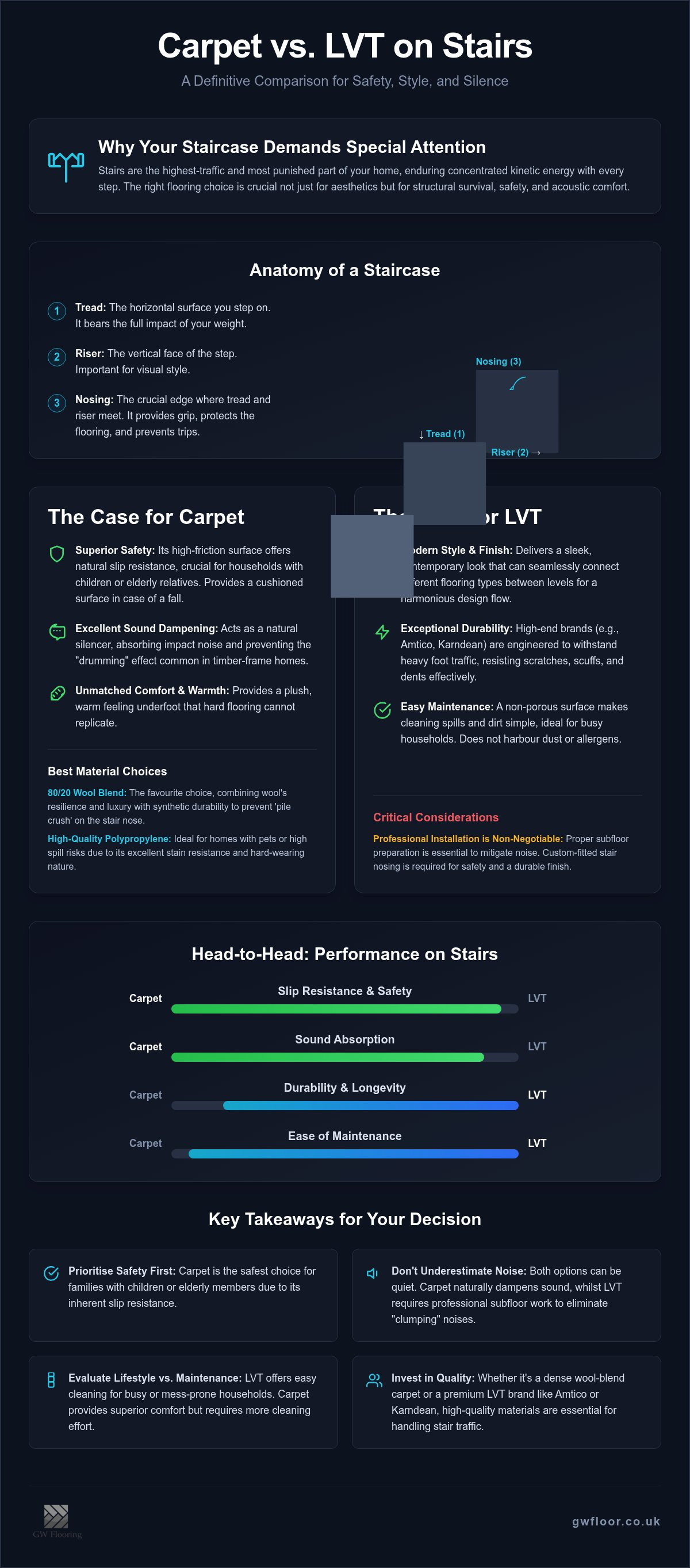
To understand the technical challenge, you need to know the anatomy of your stairs. The "tread" is the horizontal part you step on, whilst the "riser" is the vertical face. The point where they meet is the "nose". This edge is the most vulnerable part of the installation because it catches the most friction and foot-strike impact. Stair nosing is a specialised profile fitted to the edge of each step that provides essential grip, protects the flooring material from chipping or fraying, and creates a visible border to prevent trips.
Noise Transfer in Traditional Essex Homes
Sound behaves differently depending on your home's construction. Traditional timber-frame stairs found in many Essex properties can act like a resonator, amplifying the sound of footsteps into a hollow "drumming" effect. If you choose a hard surface like Luxury Vinyl Tile, the impact noise can travel through the frame and into adjacent bedrooms. Whilst safety is always our primary concern, acoustics are a close second. Professional subfloor preparation is the only way to mitigate this noise, ensuring that your stylish new stairs don't become a source of frustration for everyone else in the house. We focus on the invisible work behind the scenes to make sure the final result is as quiet as it is beautiful.
The Case for Carpet: Comfort, Safety, and Sound Dampening
Carpet remains the gold standard for many Essex families because it addresses the two biggest anxieties of stair renovation: slips and noise. Unlike hard surfaces, the natural fibre of a carpet provides a high-friction surface that's inherently forgiving. Whilst residential homes don't have to follow commercial OSHA stairway safety standards, the logic behind those regulations is sound; a cushioned surface significantly reduces the risk of injury if a trip occurs. Beyond safety, the acoustic benefits are transformative. As we mentioned previously, timber-frame stairs can echo, but a dense carpet acts as a natural silencer, absorbing the impact of heavy footsteps before they can vibrate through the walls.
For homeowners with winding or awkward staircases, carpet often proves more cost-effective than a complex carpet vs LVT on stairs comparison might initially suggest. Fitting LVT around tight curves requires intricate, time-consuming labour and expensive nosing profiles. Carpet, by contrast, can be expertly manipulated to follow the flow of a kite-winder staircase with a seamless, high-end finish. It also provides a level of warmth and luxury underfoot that is difficult to replicate with even the highest-quality hard flooring.
Wool vs. Synthetic: Which Survives the Stairs?
We've found that an 80/20 wool blend is the firm favourite amongst our Rayleigh clients. It combines the natural resilience and luxury of wool with the durability of synthetic fibres, which is essential for preventing "pile crush" on the nose of the step. For households with pets or high-spill risks, a high-quality polypropylene carpet offers excellent stain resistance whilst remaining hard-wearing enough for daily use. Choosing the right density is vital; a thin, cheap carpet will show the shape of the stair nosing far too quickly.
Stair Runners: A Design-Led Compromise
If you love the look of LVT but want the safety of carpet, a stair runner is a brilliant solution. This approach leaves the edges of the wood or vinyl visible whilst providing a safe, quiet path down the centre. You can elevate the look with whipped edges or traditional brass stair rods for a timeless aesthetic. If you're struggling to visualise how this would look in your hallway, we can bring our full range of samples to your home so you can see the textures in your own light.
The Case for LVT: Modern Style, Durability, and Easy Maintenance
Luxury Vinyl Tiles (LVT) represent the ultimate hard-wearing solution for a modern Essex home. Unlike carpet, which can bald or fray on the edges after years of heavy use, LVT maintains its crisp profile and structural integrity. This is why a carpet vs LVT on stairs comparison often leans toward vinyl for busy households. If you have muddy boots coming in from the garden or pets racing up and down, LVT is the clear winner for hygiene. A quick wipe-down removes allergens and dirt that would otherwise get trapped deep in carpet fibres, making it a dream for easy maintenance.
However, the success of LVT on stairs depends entirely on the invisible work. You can't simply glue tiles to old timber treads and expect a professional result. We include professional plyboarding and screeding in our quotes because a perfectly flat foundation is essential. Without this meticulous preparation, the tiles will telegraph every imperfection underneath, leading to a poor finish and potential failure. This focus on Durability & Stability ensures your investment stands the test of time, even in the highest-traffic areas of your property.
The Critical Role of Stair Nosings
Nosing is the technical term for the edge of the step, and with LVT, it's a non-negotiable safety feature. You can choose colour-matched nosings for a seamless, wrapped look or contrasting metal profiles for a contemporary aesthetic. These nosings do more than just look good; they mechanically lock the LVT in place, preventing the edges from lifting under the constant pressure of foot traffic. In 2026, we utilise nosings with high-performance slip-resistant inserts to ensure every step is as secure as possible, meeting modern safety expectations without compromising on style.
Amtico and Karndean for High-Traffic Stairs
Premium brands like Amtico and Karndean are our go-to recommendations for staircases. These manufacturers provide superior grip ratings, which is vital when moving away from the natural traction of carpet. Many Essex hallways are flooded with natural light, so we prioritise LVT with UV-stable layers to prevent fading over time. If you want to understand the technical differences between these luxury options, you can read our Amtico vs Karndean comparison in our complete 2026 guide. This level of design flexibility allows you to match your stairs perfectly to your hallway LVT, creating a cohesive, high-end aesthetic throughout your home.
Direct Comparison: Noise, Safety, and Longevity
When conducting a direct carpet vs LVT on stairs comparison, technical specifications provide the clearest path to a decision. Slip resistance is a primary concern for Essex families, particularly those with young children or elderly relatives. In the flooring industry, this is measured using R-ratings. Whilst carpet doesn't have a formal R-rating, it provides the highest natural traction available. For those choosing Luxury Vinyl Tiles, we recommend a minimum of an R10 rating for staircases. This ensures the surface has enough grip to prevent accidents, even in socks or slippers.
Acoustics represent the second major hurdle. Decibel testing consistently shows that hard surfaces can increase impact noise by up to 20dB compared to a high-quality carpet. Carpet acts as a giant silencer for your home, whereas LVT requires specific acoustic underlays to prevent that hollow "clumping" sound. For pet owners, the choice is a trade-off. LVT is impervious to claw marks and easy to wipe clean of muddy paw prints, but carpet is far better at trapping fur and providing grip for older dogs who might find hard stairs intimidating.
Installation Complexity and Timeframes
Fitting LVT on a staircase is a meticulous, disciplined process that typically takes twice as long as a carpet installation. Our team must precisely cut and mitre each tile to fit perfectly around spindles and newel posts. This is where our focus on "invisible work" becomes vital. Unlike some competitors who might glue tiles directly to old timber, we always prioritise professional plyboarding. This foundational groundwork is the only way to ensure your LVT remains stable and doesn't lift at the edges over time. A standard carpet fit is faster and more forgiving of slight subfloor imperfections, but it lacks the crisp, architectural lines of a professional vinyl installation.
Long-Term Value and ROI
Investing in your staircase adds tangible value to Rayleigh properties, but the return on investment depends on replacement frequency. A budget carpet is often a false economy; in a high-traffic Essex home, it can look worn and "crushed" within three years. By contrast, a premium LVT or a high-end 80/20 wool blend can easily last 15 years with proper care. Whilst the initial cost of LVT is higher due to the labour-intensive fitting and subfloor preparation, its longevity often makes it the more cost-effective choice over a decade. If you want to see the durability of our range for yourself, arrange a home visit from our mobile showroom today.
Choosing the Right Solution for Your Rayleigh Property
Selecting the final material for your staircase often comes down to the architectural era of your Rayleigh property. Whilst some industry voices suggest Victorian homes should exclusively feature carpet, we've seen stunning modern transformations using LVT in traditional Essex hallways. The key is ensuring the design flows naturally from the front door to the landing. A successful carpet vs LVT on stairs comparison isn't just about the material itself; it's about how that material interacts with your specific hallway lighting and the daily rhythm of your household.
Before you commit to a fitting date, we recommend running through this final checklist to ensure your choice meets your long-term needs:
- Safety first: Do you have young children or elderly relatives who require the natural grip of a carpet?
- Acoustic impact: Is your staircase located near bedrooms where the sound of footsteps might be disruptive?
- Maintenance habits: Would you prefer the quick wipe-down of LVT or the soft, vacuumed finish of a wool blend?
- Durability expectations: Are you looking for a 15-year solution or a shorter-term aesthetic refresh?
- Visual harmony: Does the sample look the same in your hallway's natural light as it did in the showroom?
The 'Invisible Work': Why Subfloor Prep is Non-Negotiable
We never skip the technical groundwork. Fitting LVT directly onto uneven or worn timber treads is a recipe for disaster; the tiles will eventually shift, and the edges will fail under pressure. To prevent this, we use 6mm plyboarding to create a perfectly level, rigid canvas for every step. This meticulous preparation ensures the adhesive bonds correctly and the finish looks like a single, seamless piece of craftsmanship. This foundational work is what distinguishes a professional installation from a quick fix. You can find more detail on our preparation standards in our Guide to Professional Floor Installation.
Ready to Transform Your Hallway?
Hallway lighting is notoriously tricky, which is why our "Showroom to You" service is so popular amongst Rayleigh and Southend homeowners. We bring our full range of Amtico, Karndean, and premium carpets directly to your doorstep. This allows you to see exactly how the colours and textures sit against your own skirting boards and wall colours. During this visit, we also perform a thorough assessment of your subfloor to provide an accurate, all-inclusive quote.
Secure your 2026 installation slot today by booking a complimentary home assessment. We take genuine pride in our meticulous approach, ensuring that your new staircase becomes a safe, stylish centrepiece that adds lasting value to your home.
Secure a Stylish Step Forward for Your Home
Deciding on the best surface for your staircase is a significant investment that impacts both the safety and the style of your home. Whether you opt for the unrivalled slip resistance of a premium wool carpet or the sleek, hard-wearing finish of luxury vinyl tiles, the success of your project rests on the technical groundwork. This carpet vs LVT on stairs comparison has highlighted that while carpet offers acoustic peace, LVT provides unmatched durability for modern life. We specialise in both materials, ensuring that detailed subfloor preparation is included as standard to guarantee a flawless, long-term result.
With over 20 years of family-run expertise, our specialist fitters cover all of Essex, bringing the showroom directly to your doorstep. Seeing samples in your own hallway lighting is the only way to be certain of your choice before you commit. Book your free 'Showroom to You' home visit in Rayleigh today to discuss your vision with an expert. We look forward to helping you create a safe, stunning centrepiece that your family will take pride in for years to come.
Frequently Asked Questions
Is LVT on stairs too slippery for children or pets?
LVT is safe for families if you choose a product with a high slip resistance rating, such as R10. Premium brands like Amtico and Karndean feature textured surfaces specifically designed to improve traction. Whilst carpet is naturally more "grippy", modern luxury vinyl is far safer than older, smoother materials. It is a vital consideration in any carpet vs LVT on stairs comparison for busy households.
How do you finish the edges of LVT on stairs?
We finish the edges using professional stair nosings that wrap securely around the tread. These profiles are essential for protecting the edge of the tile from lifting and provide a stable surface for your foot. You can select colour-matched nosings for a seamless look or contrasting metal finishes for a modern aesthetic. This ensures a disciplined, high-end finish that stays secure for years.
Can you put LVT over existing carpet on stairs?
No, you must always remove existing carpet and underlay before installing LVT. Luxury vinyl requires a perfectly flat, rigid subfloor to prevent the tiles from shifting or cracking. We strip the stairs back to the timber and apply 6mm plyboarding to create a smooth, level canvas. Attempting to fit over carpet would lead to structural failure and creates a significant safety hazard for your home.
Which is more expensive to fit on stairs: carpet or LVT?
LVT is generally more expensive to install due to the intensive labour and meticulous subfloor preparation required. Fitting luxury vinyl involves intricate mitring and plyboarding every individual step. Carpet is usually faster to install and more forgiving of slight subfloor imperfections. However, many homeowners find the long-term durability and ease of cleaning with LVT provide better value over a fifteen-year period.
How do I clean carpet on stairs without a heavy vacuum?
Use a cordless handheld vacuum or a specialised stair tool for easier maintenance. Carrying a heavy upright vacuum up and down can be physically demanding and potentially dangerous. Many Essex homeowners prefer using a stiff brush to loosen debris before using a lightweight handheld unit. For deep cleans, a small carpet spot-cleaner is highly effective for removing stains on treads without the bulk of a full-sized machine.
Does LVT on stairs make a lot of noise when walking up and down?
LVT can be noisier than carpet, but professional installation significantly dampens the impact sound. Without proper preparation, you may hear a hollow "clumping" noise. We mitigate this by using high-quality acoustic underlays and ensuring the 6mm plyboarding is securely fixed to the timber. If silence is your absolute priority, carpet remains the superior choice for sound absorption in traditional timber-frame Essex homes.
How long does it take to carpet a standard flight of stairs?
A professional team can usually carpet a standard straight staircase in three to five hours. This timeframe includes fitting gripper rods, laying the underlay, and meticulously stretching the carpet over each step. Complex kite-winder stairs or those requiring a runner with whipped edges will take longer. We always aim for a frictionless process that minimises disruption to your daily routine while maintaining our high standards of craftsmanship.
What is the best underlay for stair carpets to prevent wear?
A high-density 9mm or 11mm polyurethane (PU) foam underlay is ideal for high-traffic staircases. Stairs require a dense underlay that won't "bottom out" under constant pressure. This protects the carpet backing from the hard timber edge and prevents premature wear on the nose of the step. We avoid using very thick, soft underlays on stairs because they can make the footing feel unstable.


