

You have finally decided to rearrange the lounge for a fresh look, but as you slide the heavy sideboard away, you are met with four deep, stubborn craters that refuse to budge. It is a common frustration for many homeowners across Essex, and we understand that sinking feeling when you worry your flooring is permanently scarred. Many people find themselves searching for the best carpet for heavy furniture only after the damage is done, fearing that a DIY fix might lead to unsightly scorch marks or damp patches that make the situation worse.
We know how much pride you take in your home's appearance, and we're here to reassure you that most dents aren't a death sentence for your pile. In this guide, we'll share five professional-approved methods to restore your carpet's plush texture and eliminate those marks for good. Our team has spent over 20 years learning that the secret to a resilient finish often lies in the invisible work, such as high-quality underlay and proper subfloor preparation. From steam techniques to simple household hacks, you will learn exactly how to revive your space, prevent future damage, and identify when a carpet is truly beyond repair.
Key Takeaways
- Learn how "pile memory" affects your carpet's recovery and why specific moisture levels are required to lift stubborn indentations.
- Master the ice cube and steam techniques to safely restore crushed fibres without risking permanent heat damage or staining.
- Discover why selecting the best carpet for heavy furniture involves prioritising high-density underlay and expert subfloor preparation to prevent deep dents.
- Understand how to identify your carpet fibre type to ensure you apply the correct restoration method for natural or synthetic materials.
- Recognise the warning signs that a carpet is beyond repair, such as delaminated backing or fibres that have fused together over time.
Understanding Why Furniture Dents Form in Your Carpet
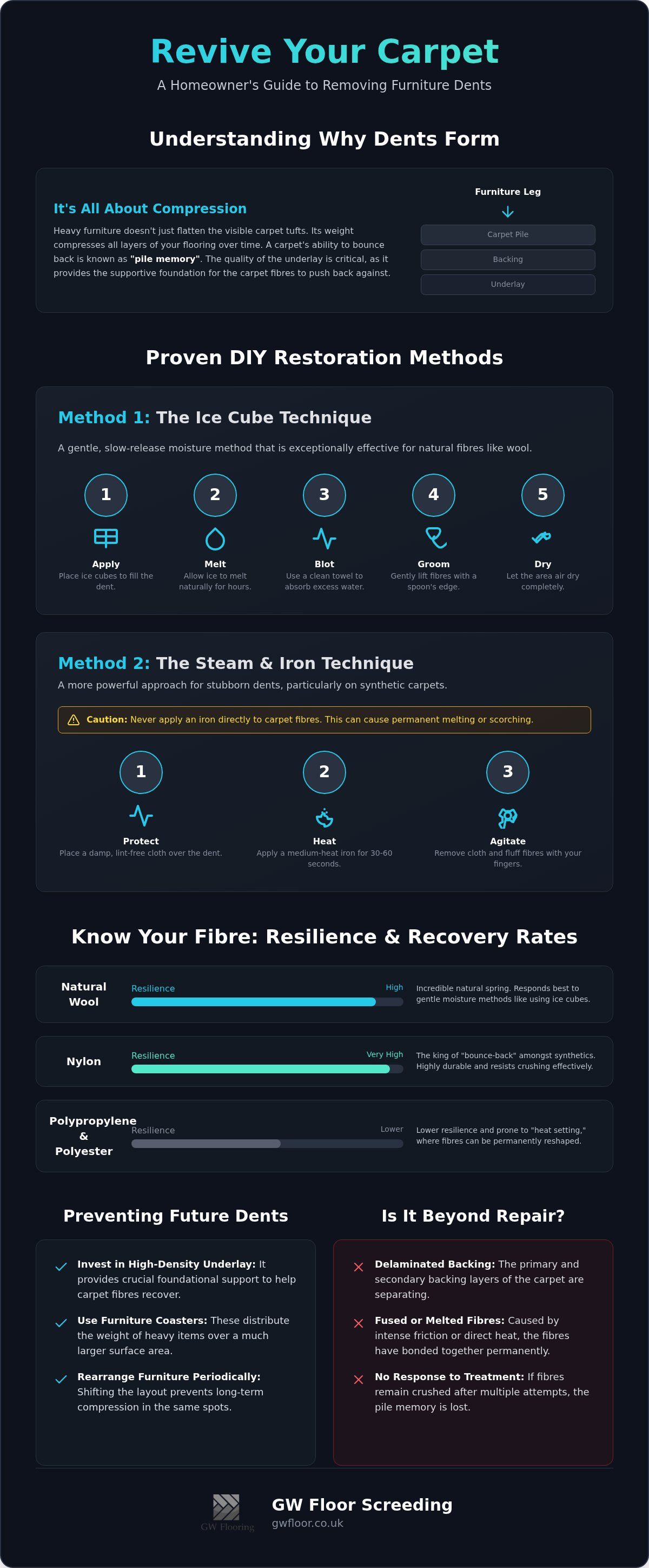
When you move a heavy sofa or a solid oak wardrobe, those unsightly craters left behind can feel like a permanent scar on your room's aesthetic. A carpet dent is more than just flattened fluff; it is the physical compression of the Carpet fibres and the secondary backing material. This happens when the weight of a heavy object exceeds the resilience of the pile over an extended period. In our 20 years of fitting floors across Essex, we've seen how the "pile memory" of a material dictates how quickly it recovers. Some carpets possess a natural spring that allows them to bounce back, whilst others remain crushed without professional intervention.
Household furniture like dining tables, heavy beds, and display cabinets are the primary culprits. In the UK, our fluctuating humidity and internal temperatures also play a quiet role. High moisture levels in the air can soften natural fibres like wool, making them more pliable and susceptible to deep impressions if you haven't invested in the best carpet for heavy furniture.
The Anatomy of a Carpet Indentation
An indentation is a structural issue that starts at the surface and travels deep into the foundation. When a heavy leg rests on a single spot, the weight isn't just pressing on the visible tufts. It pushes through the primary and secondary backings and into the underlay. This is why we always tell our Rayleigh clients that the quality of the "invisible work" matters most. A cheap, low-density underlay will collapse under pressure, leaving the carpet fibres with no support to push back against. Temporary compression becomes permanent fibre crushing when the structural integrity of the individual tufts is compromised by lack of foundational support.
Fibre Types and Their Recovery Rates
Choosing the best carpet for heavy furniture often comes down to the specific fibre's chemical or natural makeup. Understanding these differences helps you manage expectations when rearranging your home.
- Natural Wool: Known for its incredible resilience. Wool fibres are like tiny springs, but they often need a little moisture to "reset" their memory after long-term compression.
- Nylon: Amongst synthetics, nylon is the king of bounce back. It's highly durable and resists crushing better than most other man-made materials.
- Polypropylene and Polyester: These are popular for their stain resistance, but they have lower resilience. They are prone to "heat setting," meaning if they're crushed for too long, the fibres can lose their shape permanently if not treated correctly.
Proven DIY Methods for Removing Carpet Dents
Whilst choosing the best carpet for heavy furniture goes a long way in preventing damage, indentations are often an unavoidable part of home life. If you have recently rearranged your lounge, you might be staring at deep craters where the sofa once sat. Thankfully, most fibres can be coaxed back into their original shape using simple household items. These techniques align with general maintenance advice from industry bodies like the Carpet and Rug Institute, focusing on moisture and heat to reactivate the pile's memory.
Step-by-Step: The Ice Cube Method
This is a slow-release moisture technique that works exceptionally well for natural fibres like wool. It allows the moisture to penetrate deep into the compressed backing without over-saturating the surrounding area.
- Apply: Place ice cubes directly into the dented area. Use enough cubes to fill the crater completely.
- Melt: Allow the ice to melt naturally over several hours. Do not rush this process with a hairdryer.
- Blot: Once melted, use a clean, light-coloured towel to blot excess water. This prevents dye transfer from the towel to your carpet.
- Groom: Use the edge of a blunt spoon or a dedicated carpet groomer to gently lift the damp fibres.
- Dry: Let the area air dry naturally before replacing any furniture or walking on the patch.
Step-by-Step: The Steam and Iron Method
For synthetic floor coverings that require a bit more encouragement, heat can be a powerful ally. This method is a professional-style approach for stubborn marks that refuse to budge with moisture alone.
- Protect: Place a damp, lint-free cloth over the indentation. This acts as a buffer between the heat and the pile.
- Heat: Apply a medium-heat iron over the cloth for 30 to 60 seconds. Never touch the iron directly to the carpet fibres.
- Agitate: Remove the iron and cloth, then vigorously fluff the fibres with a coin or spoon whilst the steam is still active.
- Safety: Do not use this on polypropylene or other low-melting-point synthetics without performing a discreet test patch first.
If you are dealing with particularly delicate or antique rugs, the blow dryer and mist method is a safer alternative. Simply mist the area with a spray bottle and use a hair dryer on a cool setting whilst brushing the pile upwards. If these DIY fixes aren't yielding the flat, uniform surface you desire, it might be time to seek expert advice. For those in Essex looking for a more permanent solution, our team at GW Flooring can help you select a more resilient pile for your next renovation.
Matching the Method to Your Carpet Fibre Type
Applying a single restoration technique to every floor in your home is a risky strategy. Modern floor coverings vary wildly in their chemical makeup, and what works for a luxury wool lounge might ruin a synthetic bedroom carpet. If you've lost your original fitting receipt, you can usually identify the material by its look and feel. Natural fibres tend to have a matte finish and a slightly irregular texture, whilst man-made tufts often have a subtle sheen. Knowing your fibre type is the first step in learning how to get dents out of carpet without causing permanent damage. If you're still unsure, a simple 'snip and burn' test on a spare offcut can be revealing. Wool smells like burning hair and leaves a crumbly ash, whereas synthetic fibres melt and smell like plastic.
Restoring Wool and Natural Fibre Carpets
Wool remains a favourite for Rayleigh homeowners because of its natural elasticity. This resilience is due to the protein bonds within the fibre, which act like tiny internal springs. When these springs are crushed by a heavy sideboard, they require deep hydration to reset their memory. Moisture allows the fibres to swell and regain their original posture. However, you must be cautious with thick-pile wool. Over-saturating the area can lead to mildew if the moisture reaches the backing and can't evaporate quickly. We always recommend using small amounts of water and ensuring the room is well-ventilated to assist the drying process.
Handling Man-Made and Synthetic Materials
When dealing with polypropylene or polyester, the rules change entirely. These materials have what we call a glass transition temperature. This is the point at which the plastic fibres soften and can be permanently reshaped. If you use a steam iron that is too hot, you risk melting the tufts into a hard, shiny patch that is impossible to fix. For these synthetics, the best carpet for heavy furniture often features a denser tuft count that resists crushing in the first place. If dents do occur, focus on physical agitation rather than soaking. Brushing the pile vigorously with a stiff brush or using a vacuum cleaner with a beater bar can often lift the fibres more effectively than water alone. The mechanical action of the vacuum helps pull the compressed tufts back into a vertical position without the risk of heat damage.
Professional Secrets for Preventing Future Carpet Dents
Preventing indentations is far more effective than trying to fix them once the damage has occurred. Whilst we have explored several ways to lift crushed fibres, the real secret to a pristine floor lies in how you set up your room from day one. Even when you invest in the best carpet for heavy furniture, the way you distribute weight and maintain the pile will dictate how well the surface recovers when you eventually decide to rearrange your lounge. In our 20 years of serving homeowners across Rayleigh and the wider Essex area, we've found that a few simple professional habits can extend the life of your flooring by years.
One of the most effective strategies is regular furniture rotation. You don't need to move your entire lounge suite every week; simply shifting a heavy sideboard or sofa by just two or three centimetres every few months prevents the fibres from "heat setting" into a permanent crater. This small adjustment allows the pile to breathe and recover before the compression becomes irreversible. Additionally, regular professional cleaning helps maintain fibre elasticity, ensuring the tufts remain resilient against the weight of your favourite furniture pieces.
Choosing the Right Furniture Protectors
The point of contact between your furniture and the floor is where the most damage occurs. Caster cups are significantly better than felt pads for carpeted surfaces because they are designed to spread the heavy load across a wider surface area. For those who worry about the aesthetic of their room, transparent plastic or acrylic cups are almost invisible whilst providing essential protection. We always recommend choosing protectors with a wider base for deep-pile carpets, as this prevents the sharp legs of dining tables or wardrobes from piercing through the tufts and into the backing.
The Foundation: Why Underlay Matters
This is where the "invisible work" truly proves its value. Many people make the mistake of pairing a premium carpet with a cheap, low-density underlay, which is a false economy. A low-quality foundation will collapse under the constant pressure of heavy items, leaving the carpet fibres with nothing to bounce back against. This lack of support is the primary cause of permanent crushing that no amount of ice or steam can fix.
At GW Flooring, we always recommend specific high-density underlays for heavy-use rooms. These specialist foundations are designed to absorb weight effectively and protect the structural integrity of your floor. Coupled with professional subfloor preparation, a high-quality underlay ensures your carpet remains plush and uniform for its entire lifespan. If you are planning a room refresh and want to ensure your new flooring stands the test of time, contact our Rayleigh experts for a professional assessment of your subfloor and underlay needs.
When Dents Signal It is Time for a Carpet Refresh
Sometimes, despite your best efforts with ice cubes or steam, a carpet indentation simply refuses to budge. Whilst many marks are reversible, there comes a point where the structural integrity of the floor covering is compromised. In our two decades of experience, we've seen that deep craters often mask more serious underlying issues. If the backing of the carpet has delaminated; meaning the secondary layer has separated from the primary tufts; no amount of pile grooming will restore the flat surface. This usually happens when the weight of a heavy wardrobe has physically crushed the glue bonds over several years.
Another sign that your flooring has reached the end of its life is "fusing." This occurs primarily in synthetic materials where the combination of long-term pressure and friction causes the individual plastic fibres to melt together. When this happens, the tufts lose their individual definition and become a solid, matted patch. If you are noticing these signs, it might be time to explore modern home flooring options in Rayleigh that offer better resistance to heavy loads.
Assessing the Damage: Repair vs. Replace
We recommend a simple "three attempts" rule for any stubborn mark. If you have tried professional-grade restoration techniques three times without seeing a visible improvement, the damage is likely permanent. You should also look closely for "shading" or permanent colour loss within the dent. This often indicates that the fibres have been fractured or sheared by the weight, changing how they reflect light. Most residential carpets have a functional lifespan of 10 to 15 years. If yours is approaching this age, the fibres will naturally be more brittle and less likely to recover from furniture pressure.
Exploring Modern Alternatives in Rayleigh
If you find yourself constantly battling dents, you might consider moving away from traditional pile altogether. Luxury Vinyl Tiles (LVT) have become a firm favourite amongst our Essex clients for furniture-heavy rooms. LVT provides the aesthetic of natural materials with incredible indentation resistance, making it the best carpet for heavy furniture alternative. When you are ready to upgrade, we suggest consulting with Professional Carpet Fitters in Essex to ensure your new installation includes the correct subfloor preparation.
Our team at GW Flooring offers a "showroom to you" service, allowing you to see how different pile densities and materials look under your own light. We can provide a professional assessment of your current flooring and help you choose a replacement that balances luxury with long-term durability. Whether you want a resilient wool-mix or a high-performance synthetic, we ensure the foundation is right from the start.
Revive Your Space and Protect Your Flooring Investment
Restoring your carpet's plush pile is often a simple matter of moisture and patience. By matching the right restoration technique to your specific fibre type, you can eliminate unsightly marks and bring a sense of uniform beauty back to your rooms. We have seen that the most resilient homes are those where the foundation is prioritised. Choosing the best carpet for heavy furniture isn't just about the top layer; it's about the invisible work of premium underlay and meticulous subfloor preparation that supports every tuft from beneath.
As a family-run business with over 20 years of expert installation experience in Essex, we take genuine pride in helping homeowners realise their vision for a durable and elegant living space. If your current flooring has reached the point where DIY fixes are no longer enough, our team is ready to provide a permanent solution. Book a complimentary flooring assessment with GW Flooring today to discover how our focus on technical groundwork and high-quality materials can transform your home. We look forward to helping you achieve a flawless, dent-resistant finish that stands the test of time.
Frequently Asked Questions
Can I use a steam cleaner to get dents out of my carpet?
Yes, a steam cleaner is highly effective for lifting crushed fibres because the combination of heat and moisture reactivates the material's memory. You must exercise caution with synthetic materials like polypropylene. If the steam is too hot, it can permanently melt the tufts. Always hold the steamer a few inches away and test a small, hidden area first to ensure the heat doesn't cause discolouration or fibre damage.
How long do I need to leave an ice cube on a carpet dent?
You should leave the ice cube until it has completely melted, which usually takes several hours depending on the temperature in your Essex home. This slow-release moisture technique allows the water to penetrate deep into the backing without saturating the surrounding carpet. Once the ice has vanished, blot the area with a clean, light-coloured towel and gently groom the pile upwards with a blunt spoon to restore its original height.
Will furniture dents eventually go away on their own?
Temporary indentations caused by light items often disappear within a few days as the fibres naturally decompress. However, deep craters from heavy wardrobes or sofas usually require intervention. If you haven't installed the best carpet for heavy furniture with a high-density underlay, the weight can cause the backing to settle permanently. In these cases, the pile won't bounce back on its own and will need moisture or heat treatment to reset.
Is it possible to permanently damage carpet with heavy furniture?
Permanent damage is possible if the weight has caused the carpet backing to delaminate or the fibres to fuse together. This typically happens with older carpets or when heavy items aren't moved for many years. Once the internal structure of the tuft is fractured or the glue bonds in the backing are crushed beyond their limit, DIY methods will no longer work. At this stage, a professional assessment or a full replacement is usually necessary.
Does the type of underlay affect how badly a carpet dents?
The quality of your underlay is perhaps the most significant factor in preventing deep indentations. A cheap, low-density foundation will collapse under pressure, leaving the carpet fibres with no support to push back against. We always recommend using a high-density underlay specifically designed for heavy-use rooms. This invisible work acts as a shock absorber, distributing the weight of heavy furniture more evenly and protecting the structural integrity of your floor.
Can I use a hair dryer to fix carpet indentations?
A hair dryer is a safer alternative to an iron, especially for delicate or heat-sensitive synthetic carpets. Simply mist the dented area with a spray bottle of water and use the dryer on a medium setting whilst brushing the pile upwards with your fingers or a soft brush. Keep the dryer moving to avoid concentrated heat on one spot. This method provides enough warmth to reset the fibres without the risk of melting them.
What are the best furniture cups for deep pile carpets?
Wide-base caster cups are the most effective choice for deep pile carpets because they distribute weight over a larger surface area. Unlike narrow felt pads, these cups prevent the furniture legs from piercing deep into the tufts and reaching the backing. Choosing the best carpet for heavy furniture often involves using these protectors to ensure the pile remains resilient over time. For a discreet look, transparent plastic or acrylic cups are almost invisible.
Should I brush the carpet before or after wetting it?
You should brush the carpet after wetting it to achieve the best results. Moisture softens the fibres and resets their memory, making them much more pliable. Whilst the pile is still damp, use a carpet groomer or the edge of a spoon to lift the tufts into an upright position. Brushing before wetting is less effective because the compressed fibres are often too rigid to hold their shape without the hydration needed to unlock the indentation.


