
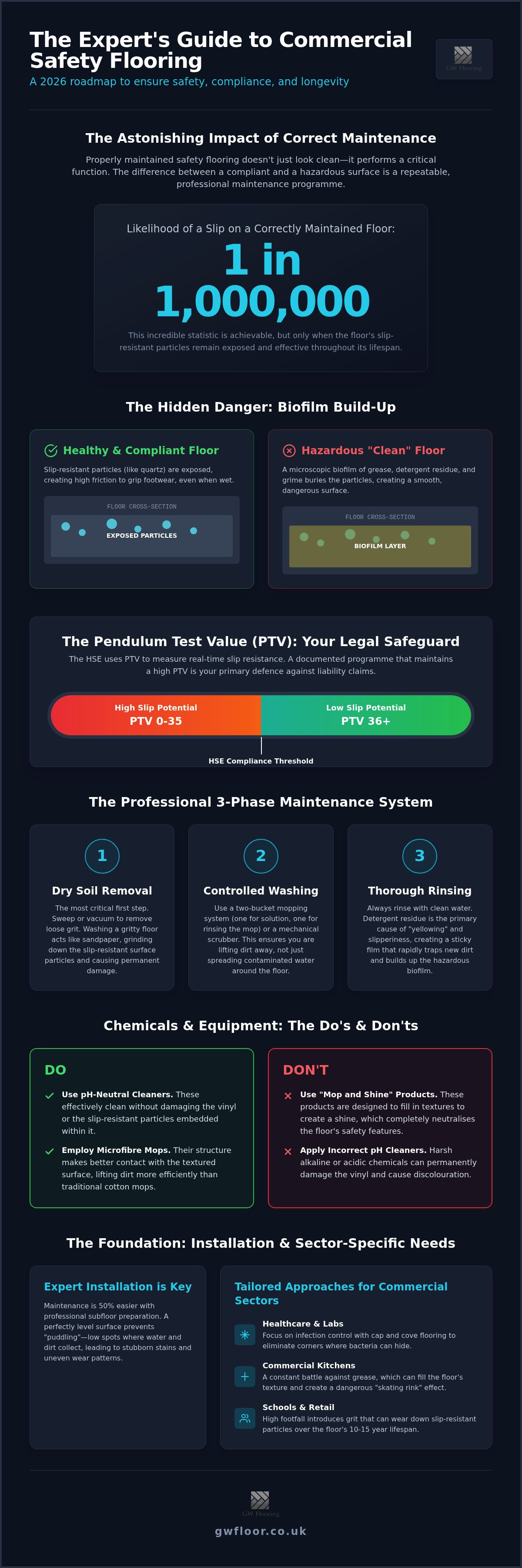
Did you know that properly maintained safety flooring can reduce the likelihood of a slip to just one in a million over its entire lifespan? It's a staggering statistic, yet many business owners in Rayleigh and across Essex find themselves staring at floors that look dull or grimy despite regular mopping. We understand the frustration of putting in the hard work only to see the slip-resistance fade or the vinyl lose its original lustre. If you're worried about passing an HSE inspection because of "greying" surfaces, you're not alone. Finding the best way to maintain commercial safety flooring is about more than just aesthetics; it's about protecting your team whilst securing your long-term investment.
In this 2026 expert guide, we share the professional secrets we've gathered over twenty years as meticulous craftsmen. We'll show you how to move beyond basic cleaning to a repeatable system that preserves a Pendulum Test Value (PTV) of 36 or higher. You'll discover the precise balance of mechanical agitation and pH-neutral chemistry needed to keep slip-resistant particles exposed without damaging the subfloor or the vinyl surface. From the latest orbital scrubbing technology to biodegradable cleaners, we'll provide a clear roadmap to ensure your floors remain safe, hygienic, and durable for years to come.
Key Takeaways
- Understand how Pendulum Test Values (PTV) and R-ratings protect your business from liability whilst ensuring full HSE compliance.
- Learn why the best way to maintain commercial safety flooring involves a strict two-bucket mopping system and why removing dry soiling is the most critical step.
- Discover why you should avoid "mop and shine" products and how the wrong pH balance can permanently damage your vinyl's slip-resistant particles.
- See how expert subfloor preparation prevents "puddling" and uneven wear patterns, significantly reducing the effort required for your daily maintenance.
- Recognise the signs of "end-of-life" for your flooring to decide whether a deep scrub restoration or a full replacement is the safest choice for your premises.
Understanding Safety Flooring Performance and HSE Standards
Commercial safety flooring is a high-performance material specifically engineered to prevent accidents. Unlike standard vinyl, it is infused with slip-resistant particles such as silicon carbide or quartz. These grains act like invisible teeth, biting into the soles of shoes to provide traction even when the surface is wet. However, the best way to maintain commercial safety flooring starts with understanding that its performance is a living metric. Over time, these particles can become buried under a "biofilm" of grease, skin cells, and detergent residue. This build-up creates a smooth, dangerous surface that looks clean to the naked eye but fails every safety test. Much like how property owners rely on specialists like Advanced Roofing to ensure structural safety from above, keeping your floors clean and slip-resistant is a vital component of holistic facility care.
We often see businesses focusing solely on the R-rating, which ranges from R9 for dry areas to R13 for steep ramps. Whilst these ratings are vital for initial specification, they only remain valid if the floor is kept in its original condition. A "clean" floor in a commercial kitchen or a hospital ward can still be a liability if the maintenance routine doesn't actively strip away the microscopic layers that mask the grit. If the texture is filled with residue, the slip-resistance is effectively neutralised.
The Legal Implications of Poor Floor Maintenance
Under the Workplace (Health, Safety and Welfare) Regulations 1992, employers have a legal duty to ensure floors are not slippery. If an accident occurs, the Health and Safety Executive (HSE) will look for a documented maintenance programme as evidence of your due diligence. They use the Pendulum Test Value (PTV) to measure slip resistance in real-time. For a floor to be considered low risk in 2026, it must achieve a PTV of 36 or higher. Having a repeatable, documented schedule isn't just about hygiene; it's your primary defence against costly legal claims and insurance disputes.
Common Commercial Sectors and Their Specific Needs
Different environments in Rayleigh and across Essex demand tailored approaches to keep surfaces safe. In healthcare and laboratories, we prioritise infection control using cap and cove flooring, which wraps the vinyl up the wall to eliminate corners where bacteria hide. Commercial kitchens face a constant battle against grease. Without the correct floor cleaning methods, oils become trapped in the texture of the safety vinyl, creating a skating rink effect. In schools and retail spaces, high footfall means the grit can eventually wear down. We always remind our clients that maintenance is 50% easier when you have expert subfloor preparation, as a perfectly level surface prevents the "puddling" that attracts dirt and stubborn stains.
The Best Daily and Weekly Maintenance Programme
Establishing a clear, repeatable schedule is the best way to maintain commercial safety flooring and protect your investment over its 10 to 15-year lifespan. We've seen many businesses in Rayleigh struggle with floors that look "grimy" simply because they've missed the foundational steps of a professional routine. A successful programme is split into three distinct phases: dry soil removal, controlled washing, and thorough rinsing.
Phase 1 is often the most overlooked. Removing dry soiling before water touches the floor is critical because loose grit acts like sandpaper underfoot, grinding down the slip-resistant particles. Once the dry debris is gone, you can move to Phase 2. We recommend the "two-bucket" mopping method or, for larger Essex facilities, mechanical scrubbing. The two-bucket system ensures you aren't just moving dirty water around the room; one bucket holds your cleaning solution whilst the other is for wringing out the soiled mop. Finally, Phase 3 is the rinse. Leaving detergent residue on the surface is the primary cause of "yellowing" and increased slipperiness, as it creates a film that traps new dirt. Following the HSE guidance on floor cleaning ensures your team isn't inadvertently creating a hazard by leaving behind chemical films.
The Daily Routine for High-Traffic Areas
- Step 1: Sweep or vacuum the entire area. Pay special attention to entrance ways where external grit is most concentrated.
- Step 2: Apply a pH-neutral cleaner using a microfibre mop. These mops provide better surface contact with the "teeth" of the safety vinyl than traditional cotton versions.
- Step 3: Spot-clean spillages as they happen. In a busy commercial environment, immediate action prevents oils or liquids from bonding with the floor's texture.
The Weekly Deep Clean Protocol
Once a week, your floor needs more than just a surface wipe. We suggest using a deck scrubber or a cylindrical brush machine to reach the dirt trapped deep within the vinyl's profile. You should focus heavily on the edges and corners, particularly in cap and cove installations where hygiene is paramount. This is also the time to inspect your heat-welded seams. If you notice any gaps or signs of water ingress, it's vital to address them before the subfloor becomes compromised. If you're unsure about the current state of your floor's seams, we're always happy to provide a professional assessment to ensure your premises remain fully compliant.
Choosing the Right Cleaning Chemicals and Equipment
The best way to maintain commercial safety flooring isn't just about effort; it's about accuracy in your chemical selection. Using the wrong product can turn a high-end installation into a brittle, yellowed liability. We've seen many Essex business owners make the mistake of using aggressive domestic cleaners that strip the plasticisers from the vinyl, leading to premature cracking. The science of pH is central here. Ideally, you should stick to pH-neutral cleaners for daily maintenance. Highly alkaline solutions (pH 10+) should be reserved for periodic deep cleans to strip grease, whilst acidic cleaners are only for specific mineral scale removal. If you're unsure, remember that neutral is always the safest bet for the longevity of your floor.
You must never use "mop and shine" or any wax-based products on safety flooring. These products are designed to create a smooth, reflective film, which is the exact opposite of what a slip-resistant surface needs. These coatings fill the microscopic valleys between the silicon carbide or quartz particles, effectively "burying" the grit and creating a skating rink. For larger Rayleigh warehouses or clinical spaces, we recommend moving away from manual mopping toward automatic scrubber-dryers. These machines apply fresh solution and immediately vacuum up the dirty slurry, ensuring no residue is left behind to dry on the surface.
Sustainability is a major focus in 2026. We're seeing a significant shift toward biodegradable, eco-friendly cleaning agents like "Triple 8 BioGen". These products prove that you don't need harsh, VOC-heavy chemicals to tackle industrial grease. They work through biological action to break down oils, making them a responsible choice for businesses looking to reduce their environmental footprint without compromising on safety.
Essential Equipment for Commercial Success
- Microfibre vs. Cotton: Always choose microfibre. Traditional cotton mops often leave lint behind and can't reach into the textured profile of safety vinyl as effectively as microfibre hooks.
- Pad Selection: When using mechanical scrubbers, the colour of the pad matters. Red pads are generally best for safety flooring as they provide enough agitation to dislodge dirt without being overly abrasive. White pads are too soft, whilst black pads are usually too aggressive for daily vinyl care.
- Wet Vacuums: These are the unsung heroes of maintenance. If you're mopping manually, a wet vacuum is essential to remove the dirty water before it can settle back into the floor's texture.
Chemical Safety and Dilution Control
Precision in dilution is vital for a safe floor. Under-diluted, concentrated chemicals leave a sticky, tacky residue that actually attracts more dirt and makes the floor harder to clean next time. We suggest using automated dilution stations to ensure every bucket is mixed perfectly. To maintain hygiene standards, implement a colour-coded system: blue for general areas, red for toilets, and green for kitchens. This prevents cross-contamination and ensures your Rayleigh facility remains compliant with COSHH regulations regarding the safe storage and use of hazardous substances.
How Professional Installation Simplifies Long-Term Care
At GW Flooring, we believe the best way to maintain commercial safety flooring starts long before the first mop hits the surface. Our twenty years of experience in Rayleigh have taught us that maintenance struggles are often symptoms of poor "invisible work" during the installation phase. If your subfloor isn't perfectly level, you'll face "puddling," where cleaning water and grease settle in microscopic dips. These areas become impossible to clean with standard equipment, leading to dark patches and a loss of slip-resistance. This is why expert subfloor preparation is the most critical investment you can make for the longevity of your business floors.
High-quality screeding creates a glass-smooth foundation that allows your cleaning tools to glide effortlessly. When the subfloor is flat, the safety vinyl doesn't have to contour over bumps, which prevents uneven wear patterns that trap dirt. For environments like commercial kitchens or laboratories, we always advocate for cap and cove skirting. By wrapping the flooring up the wall to form a skirting, we eliminate the 90-degree corner where bacteria and grime usually accumulate. This creates a seamless, easy-clean radius that makes your daily hygiene routine significantly faster and more effective.
The Impact of Subfloor Moisture on Maintenance
Many older Essex commercial properties suffer from rising damp that can compromise even the best cleaning regime. Without a correctly installed damp-proof membrane (DPM), moisture can cause safety vinyl to bubble, creating pockets that trap stagnant water and bacteria. Subfloor screeding is the essential foundation for floor longevity, providing the perfectly flat and stable surface required for safety materials to perform. If these foundational steps are ignored, the floor will eventually lift, making it a trip hazard regardless of how clean the surface appears.
Why Heat-Welded Seams Matter for Hygiene
Professional heat welding is what turns individual sheets of vinyl into a monolithic, waterproof surface. If the seams aren't welded with precision, cleaning water will inevitably seep under the floor, causing the adhesive to fail and the vinyl to curl. You should regularly check your seams for signs of discolouration or lifting, as these are the first indicators of water ingress. Poor seams don't just look untidy; they are a direct threat to the structural integrity of your flooring investment. If you're concerned about the condition of your current installation, contact our team for a professional assessment to ensure your floors remain safe and compliant.
Specialist Maintenance and When to Consider Replacement
Even with a rigorous cleaning schedule, every commercial floor has a finite lifespan. The best way to maintain commercial safety flooring involves a keen eye for when the material is no longer fit for purpose. You'll notice signs of "end-of-life" when the slip-resistant grit, those essential silicon carbide or quartz particles, begins to thin or disappear entirely. If your floor feels smooth underfoot despite being dry, it's likely that the wear layer has been compromised, and the surface may no longer meet the required Pendulum Test Value (PTV) of 36. At this stage, the floor becomes a liability rather than an asset.
We are often asked if a "Deep Scrub and Recoat" can save an old surface. Whilst this can temporarily improve the appearance of standard vinyl, safety flooring is different. Once the integrated grit is worn away, no amount of chemical cleaning can restore its original slip-resistance. For businesses in Rayleigh and across Essex, upgrading to newer PUR (Polyurethane) reinforced safety vinyls is often the most cost-effective path. These modern materials are specifically designed to resist staining and scuffing, making them significantly easier to clean than the safety floors of a decade ago. If you're considering an upgrade, our "Showroom to You" service brings the latest samples directly to your premises, allowing you to see how different textures and colours work in your specific environment.
Troubleshooting Common Maintenance Issues
Daily life in a busy commercial setting brings unique challenges. Rubber-soled shoes can leave stubborn scuff marks that don't shift with standard mopping. We recommend using a specialised spot cleaner or a white non-abrasive pad to lift these without dulling the vinyl. If you notice "yellowing" in certain areas, it's usually a sign of UV exposure or, more commonly, a build-up of alkaline residue from incorrect chemical use. During Essex winters, salt and grit tracking from the street can be particularly abrasive. Increasing the frequency of your dry soiling removal during these months is the best way to prevent this grit from acting like sandpaper on your floor's surface.
Planning for a Floor Upgrade
When the cost of constant deep cleaning outweighs the benefits, it's time to calculate your ROI on a new installation. Modern safety flooring has evolved; it no longer needs to look "industrial" or clinical. You can now choose from a wide variety of sophisticated designs that mimic natural wood or stone whilst providing R10 to R12 slip-resistance. We understand that closing your doors for a renovation isn't always an option. As professional commercial flooring specialists, we pride ourselves on managing out-of-hours fittings to ensure zero disruption to your daily operations. A new, high-quality floor, supported by our signature foundational subfloor work, will ensure your staff and customers remain safe for the next decade.
Future-Proofing Your Business Floors
Ensuring your commercial space remains safe and compliant doesn't have to be a source of constant stress. We've established that the best way to maintain commercial safety flooring is a combination of meticulous daily care and the right chemical choices. By prioritising dry soil removal and using pH-neutral cleaners, you protect the essential slip-resistant particles that keep your Pendulum Test Values high. Remember that a floor's performance is only as good as the preparation beneath it; expert subfloor work is the "invisible" secret to a long-lasting, easy-clean surface.
As a family-run business with over 20 years of Rayleigh-based expertise, we take genuine pride in helping local firms achieve HSE-compliant results. Whether you're managing a busy kitchen or a clinical cleanroom, we're here to share our craft and eliminate the guesswork of floor care. Book a free site survey for your Essex business with GW Flooring today to see how we can transform your maintenance routine and protect your investment. We look forward to helping you realise a safer, more durable vision for your workspace.
Frequently Asked Questions
Can I use bleach to clean my commercial safety flooring?
You should avoid using concentrated bleach on your vinyl surfaces. Whilst it's a powerful disinfectant, bleach is highly alkaline and can cause the flooring to yellow or become brittle over time. This chemical damage compromises the material's integrity and can even affect the bond of the slip-resistant particles. For a safe and effective result, we recommend sticking to specialised pH-neutral detergents that clean without attacking the vinyl's structure.
How often should a commercial kitchen floor be deep cleaned?
In a busy Essex kitchen, you should perform a thorough wash daily to manage grease build-up. However, a mechanical deep clean with a scrubber-dryer or deck brush is recommended at least once a week. This intensive process ensures that oils don't settle into the textured profile of the floor. Regular deep cleaning is the best way to maintain commercial safety flooring in high-risk environments where grease can quickly neutralise slip-resistance.
What is the best mop for non-slip vinyl flooring?
Microfibre flat mops are the superior choice for slip-resistant textures. Unlike traditional cotton mops that leave lint behind and struggle to reach into the floor's "teeth," microfibre features tiny hooks that physically grab dirt from the valleys of the vinyl. They also use less water, which helps the floor dry faster. We always advise our Rayleigh clients to avoid string mops as they often just move dirty water around.
Why does my safety floor still look dirty after mopping?
This is usually caused by a build-up of "slurry" or detergent residue. If you don't rinse the floor with clean water after mopping, the dirty solution dries back into the texture, creating a dull, grey film. Over time, this biofilm masks the floor's original colour and slip-resistant grit. Switching to a two-bucket system or using a wet vacuum to remove the dirty water before it dries will solve this common issue.
Do I need to polish or wax commercial safety flooring?
You must never apply polish or wax to safety flooring. These products are designed to create a smooth, sacrificial layer that fills in surface imperfections to provide a shine. On a safety floor, this process effectively "buries" the slip-resistant particles under a slippery coating, turning a safe surface into a major hazard. Safety vinyl is engineered to perform without additional coatings, provided it's kept clean using the correct methods.
How long should commercial safety flooring last with proper maintenance?
When installed by professionals and cared for correctly, you can expect your commercial safety flooring to last between 10 and 15 years. The secret to this longevity is the "invisible work" we often mention, such as high-quality subfloor preparation and moisture control. Without these foundations, the floor might lift or bubble long before the wear layer actually thins out. Regular maintenance ensures the grit remains effective for the duration of the floor's life.
What is cap and cove flooring, and does it help with cleaning?
Cap and cove is a specialist installation technique where the flooring material is curved up the wall to form a skirting. This creates a seamless, monolithic surface that eliminates the 90-degree corner between the floor and the wall. It's particularly helpful for cleaning in cleanrooms and laboratories because it removes the "dirt traps" where bacteria and grime typically hide. It makes mopping much faster and ensures your facility meets high hygiene standards.
Can I use a steam mop on commercial vinyl safety floors?
We generally advise against using domestic steam mops on commercial safety vinyl. The intense, localised heat can cause the adhesive beneath the floor to soften or fail, leading to bubbling and lifting. Whilst some industrial steam cleaners are rated for specific vinyls, it's safer to stick to mechanical scrubbing or microfibre mopping with warm water. This protects the bond between the vinyl and the subfloor, ensuring your installation remains secure and flat.


