
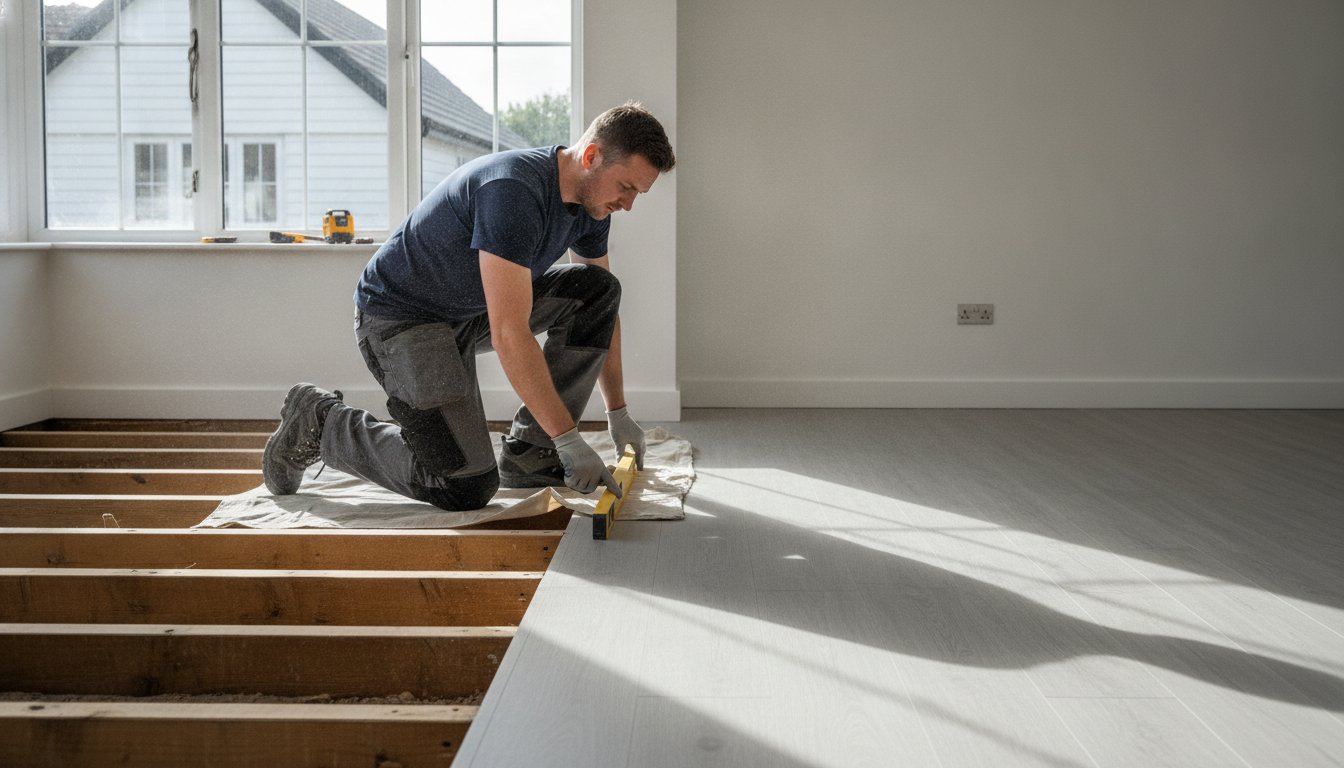
That slight spring in your step across the lounge isn't just a charming quirk of an older property; it is a "floor-killer" that can silently ruin your new LVT or carpet. We understand the hesitation you feel when planning a renovation. It's natural to worry that a beautiful new finish will eventually crack or fail because the ground beneath it isn't solid. Calculating the cost to fix a bouncy subfloor Essex homeowners encounter requires looking past the surface to the joists and boards that do the heavy lifting. You deserve a home that feels as stable as it looks, without the fear of hidden structural issues spiralling out of control.
In this guide, we'll help you identify the common causes of floor movement and show you how professional remediation protects your flooring investment. We will explore 2026 pricing for structural repairs, from simple board replacements to complex joist strengthening, whilst explaining how local building regulations might affect your project. You'll gain a clear understanding of your repair options and the meticulous groundwork we prioritise to ensure your finished floor remains silent and level for years to come. Our goal is to provide a professional assessment of the structural health of your home, helping you move forward with confidence and peace of mind.
Key Takeaways
- Identify why local soil conditions and vertical deflection lead to "springy" floors that threaten the structural integrity of your home.
- Recognise the early warning signs of subfloor movement, such as gaps at the skirting boards, before they result in expensive damage to your new flooring.
- Gain a clear understanding of how the cost to fix a bouncy subfloor Essex homeowners pay is influenced by the choice between surface-level repairs and structural joist reinforcement.
- Discover technical solutions like sistering and the use of noggins to eliminate lateral movement and provide a rock-solid foundation for LVT or carpet.
- Learn how meticulous subfloor preparation acts as an invisible insurance policy for your luxury floor, ensuring a silent and durable result that lasts for decades.
Understanding the Causes of a Bouncy Subfloor in Essex Homes
At its core, subfloor bounce is a result of excessive vertical deflection. This happens when the structural timber beneath your feet flexes beyond its intended limit under normal foot traffic. Whilst a small amount of movement is expected in timber-framed floors, a noticeable 'spring' or trampoline effect suggests that the framework is no longer supporting the load effectively. Understanding Floor Joists and how they distribute weight is the first step in diagnosing why your floor feels unstable. It's vital to distinguish between a surface-level creak, which is often just a loose board, and a deep structural bounce that indicates a failing foundation.
In our region, the geology plays a silent but significant role. Essex is famous for its heavy clay soil, which is prone to shrinking in dry summers and swelling during wet winters. These subtle foundation shifts can ripple through a property, causing the subfloor framework to pull away from its original fixings or settle unevenly. This is why we often see bounce in homes across Rayleigh and Wickford that doesn't exist in other parts of the country. When homeowners start investigating the cost to fix a bouncy subfloor Essex properties often require a bespoke approach due to these unique geological pressures.
Common Structural Culprits: Joists and Spans
Many Victorian and Edwardian builds across Essex were designed for a different era of living. We frequently find that the original joists are undersized for the modern room spans or the heavy weight of contemporary furniture and kitchen islands. Over the decades, the integrity of these timbers has often been compromised by previous trades. Common issues include:
- Aggressive Notching: Plumbers or electricians from years past may have cut deep notches into the joists to run pipes or cables, significantly weakening the timber's load-bearing capacity.
- Inadequate Spacing: Joists placed too far apart allow the subfloor material to sag between the supports.
- Hidden Decay: Our "invisible work" often involves identifying joist rot amongst hidden voids where moisture has seeped in over a century of use.
Environmental Factors in the South East
Determining the cost to fix a bouncy subfloor Essex homes need involves more than a quick glance; we have to look into the hidden voids to see what environmental factors are at play. The South East experiences significant seasonal temperature changes that cause timber to expand and contract. In older Rayleigh properties, poor ventilation in crawl spaces is a frequent offender. Without adequate airflow, humidity builds up and causes the timber to soften, leading to that dreaded springy sensation. Historical DIY repairs often make things worse by simply nailing down new boards without addressing the softened joists or the damp environment below.
Diagnosing the "Bounce": Why Your Subfloor Needs Urgent Attention
Recognising a bouncy floor often starts with a sensation rather than a sound. You might notice your favourite armchair wobbles when someone walks past, or perhaps you've spotted mysterious gaps appearing between the floor and your skirting boards. These aren't just cosmetic annoyances; they're symptoms of a subfloor that is struggling to remain stable. When homeowners ask about the cost to fix a bouncy subfloor Essex professionals usually start by looking for these tell-tale signs of deflection, as ignoring them can lead to the failure of your top-layer flooring.
Modern luxury finishes like stone-effect tiles and Luxury Vinyl Tiles (LVT) are particularly sensitive to movement. Whilst a thick carpet might mask a slight dip, rigid or click-lock materials don't have that luxury. If the subfloor flexes too much, the delicate joints in your new floor will eventually snap under the pressure. Beyond the physical damage, a bouncy floor acts like a drum skin, amplifying footsteps and allowing noise to travel effortlessly between rooms. This acoustic disruption is often what finally pushes Rayleigh residents to seek a permanent fix for their home.
LVT and the Requirement for a Dead-Level Surface
A successful LVT flooring installation Rayleigh homeowners can be proud of relies entirely on the subfloor being dead-level and rigid. LVT is designed to be thin and sleek, which means any subfloor imperfections will eventually "telegraph" through to the surface. You'll see every bump and feel every dip. Our philosophy centres on the "invisible work" of preparation; we know that spending time securing the foundation saves you thousands in potential replacements. If you're unsure about the state of your boards, we can provide a detailed subfloor assessment to ensure your investment is protected from the start.
Long-term Risks of Ignoring Subfloor Movement
Leaving a springy floor to "settle" is a gamble that rarely pays off. If the underlying cause is joist rot or damp, the structural integrity of the room is at risk. Over time, constant movement breaks down the adhesives and grout lines used in premium installations. This leads to a devalued property, as any savvy home surveyor in Essex will flag a bouncy floor as a potential structural defect. Following UK Building Regulations for Floors ensures that your repairs aren't just a quick fix but a compliant, long-term solution. Calculating the cost to fix a bouncy subfloor Essex homeowners often find that early intervention is far more budget-friendly than waiting for the joists to fail completely. Taking action now prevents a minor bounce from becoming a major structural headache later.
Breaking Down the Cost to Fix a Bouncy Subfloor in 2026
Securing a stable foundation is a vital investment in your home's longevity, but the financial layout depends entirely on whether the issue is surface-level or deeply structural. We find that the cost to fix a bouncy subfloor Essex homeowners encounter is shaped by the root cause, from simple board tightening to the complex "sistering" of floor joists. A general builder might provide a lower daily rate for a quick fix, yet a specialist flooring contractor brings the precision required for modern luxury finishes. In the South East, labour rates for skilled craftsmen reflect the high demand for quality, and choosing a specialist ensures the work meets the strict tolerances needed for premium materials.
Opting for the cheapest quote for subfloor preparation is often a "false economy." If the underlying movement isn't fully resolved, even the most expensive Karndean or Amtico floor will eventually fail, leading to a total loss of your investment. We prioritise "invisible work" because we know that a floor is only as good as the ground it sits on. Factors such as room size and accessibility also play a role; a small, cramped hallway with multiple doorways requires more intricate labour than a large, open-plan kitchen diner.
Variable Cost Factors in Subfloor Remediation
The materials we select are chosen for their durability and performance. High-grade plywood, often 6mm to 9mm thickness, provides a rigid surface, whilst specialist smoothing compounds ensure a glass-like finish for LVT. Structural repairs require C24-graded timber joists to guarantee strength. You should also consider the following logistical factors:
- Waste Disposal: Removing and skipping old, water-damaged chipboard or rotten timber adds to the overall project duration and cost.
- Finish Requirements: Preparing a floor for LVT requires a significantly higher level of precision and more expensive compounds than preparing for a thick, forgiving carpet.
- Structural Complexity: If we discover that joists have been notched too deeply by previous trades, the remedial work becomes more labour-intensive.
Understanding the Quote: What Should Be Included?
A professional quote should be transparent and comprehensive to avoid "hidden extras" midway through the build. We believe in providing a thorough survey that identifies the exact cause of the bounce before any boards are lifted. This allows us to organise a clear plan of action for Rayleigh residents, ensuring that subfloor levelling and structural reinforcement are included from the start. Your quote should never just be a "quick fix" or a patch job. It must account for the time needed to achieve a dead-level surface that complies with current standards, protecting both your home and your peace of mind.
Professional Fixes: From Joist Strengthening to Plywood Overlays
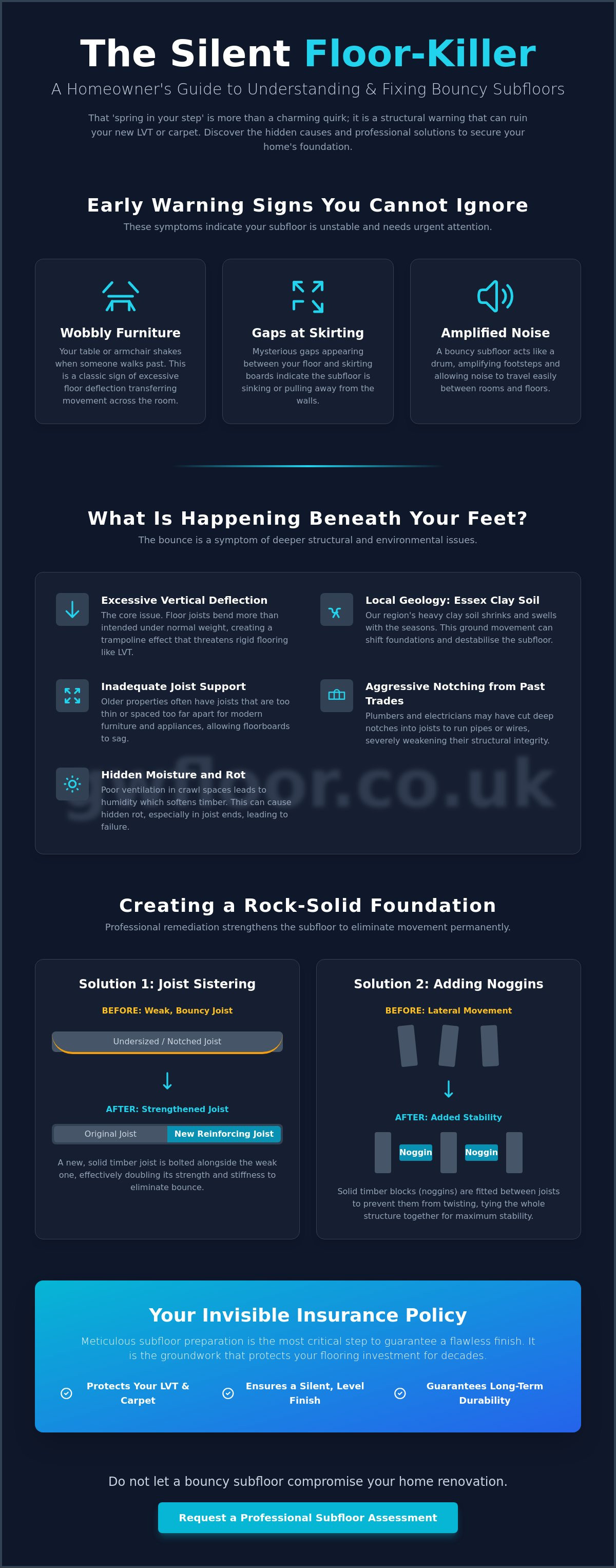
Remedying a springy floor requires a transition from diagnosis to disciplined craftsmanship. We don't believe in superficial patches that merely hide the problem. Instead, we focus on the "invisible work" that ensures your home feels solid and silent. When calculating the cost to fix a bouncy subfloor Essex homeowners often find that structural reinforcement is the most effective way to eliminate vertical deflection. The most common technical solution we employ is "sistering." This involves attaching new, C24-graded timber directly to the side of existing, weakened joists. By bolting these timbers together, we effectively double the strength of the floor's skeleton, removing the flex that causes your furniture to wobble.
To further reduce movement, we install structural noggins and bridging. These short pieces of timber are fitted between the joists to provide lateral support, stopping them from twisting or bowing under weight. Once the framework is rigid, we create a uniform surface using 6mm or 9mm plywood overlays. This layer acts as a bridge over any minor imperfections in the original boards, providing the stability required for premium finishes like Amtico or Karndean. For those choosing Luxury Vinyl Tiles, we often finish the preparation with high-quality smoothing compounds to achieve a glass-like screed that prevents any subfloor patterns from showing through the final floor.
The Structural Repair Process
Our approach to structural remediation is methodical and clean. We treat your home with the same respect we'd show our own, ensuring the process is as frictionless as possible. The standard workflow includes:
- Step 1: We carefully lift the existing floorboards or chipboard sheets to expose the timber skeleton of the room.
- Step 2: We level the joists across the entire span using mechanical fixings and shims, ensuring the foundation is perfectly horizontal.
- Step 3: We install structural noggins to distribute the load amongst the floor, significantly increasing the overall weight-bearing capacity.
Surface Preparation for a Flawless Finish
Once the structural work is complete, we turn our attention to the surface. We use mechanical fixings to secure the plywood overlays, spacing them precisely to prevent any future creaking or rubbing. We also prioritise moisture testing before any LVT or vinyl is laid; this is a critical step in Essex properties where hidden damp can compromise adhesives. We use feather-edge compounds at room transitions to ensure a seamless flow between different living spaces. This meticulous attention to detail is why we are trusted with the most demanding renovations in the region. If you're ready to secure your home's foundation, book your professional subfloor assessment with our Rayleigh team today.
By investing in these professional fixes, you aren't just stopping a bounce; you're protecting the long-term beauty of your home. The cost to fix a bouncy subfloor Essex residents invest today prevents the heartbreak of a failing floor tomorrow. We take genuine pride in delivering results that stay silent, level, and beautiful for decades.
Why GW Flooring is Rayleigh’s Choice for Subfloor Remediation
Choosing a specialist for your renovation means moving beyond simple repairs toward a lasting design partnership. We have spent over 20 years refining our craft, specifically addressing the geological and architectural quirks of properties in the South East. As a family-run business, we don't view your project as just another job; we treat your home with the meticulous care and respect it deserves. We understand that when you are investigating the cost to fix a bouncy subfloor Essex properties present unique challenges that general builders often overlook. Our tenure in the industry has taught us that a beautiful floor is only as durable as the framework beneath it.
Our "Showroom to You" service is designed to make your renovation frictionless. Instead of you travelling to a sterile shop, we bring our premium samples directly to your lounge. This allows us to perform a detailed structural assessment whilst you browse our luxury collections. Whether you require the precision of our LVT specialists or the traditional skills of our professional carpet fitters in Essex, we ensure the foundation is perfect before a single tile or roll is laid. This integrated approach ensures that the material you choose is perfectly suited to your newly stabilised subfloor.
Our Meticulous Approach to Invisible Work
We believe that foundational preparation is the absolute requirement for a high-quality finished product. We don't just cover problems with thicker underlay or more screws; we solve them from the joist up. Our 20-year reputation is built on these standards of "invisible work" that most homeowners never see but always feel. During our detailed site assessments, we identify subtle issues like joist softening or historical notching that general contractors might miss. By addressing these structural root causes, we provide a sense of security and pride that lasts long after the installation team has left.
Start Your Flooring Transformation in Essex
Transforming your living space begins with a solid foundation and a clear plan. We offer a low-friction, complimentary home assessment for residents in Rayleigh, Basildon, and Southend. This visit allows us to provide a transparent breakdown of the cost to fix a bouncy subfloor Essex homeowners can rely on, without any hidden surprises. Once your subfloor is stabilised and silent, we help you navigate our range of Amtico, Karndean, and luxury carpets to find the perfect match for your style. We are passionate about helping you realise a specific vision for your home, ensuring every step of the process is handled with disciplined craftsmanship. Book your home visit and subfloor assessment with GW Flooring today and take the first step toward a stable, beautiful floor.
Secure Your Foundation for a Flawless Home Transformation
A stable home starts beneath your feet. We've explored how addressing structural deflection and environmental factors protects your investment in luxury materials like LVT or premium carpet. By prioritising the "invisible work" of joist strengthening and meticulous subfloor preparation, you eliminate the risk of cracking joints and disruptive noise. Understanding the total cost to fix a bouncy subfloor Essex homeowners encounter allows you to plan your renovation with total confidence, moving away from temporary patches toward a permanent, silent solution.
Our family-run team brings over 20 years of local expertise directly to your doorstep with our unique showroom-to-you service. We take genuine pride in our disciplined craftsmanship, ensuring every Rayleigh home we visit receives a bespoke assessment tailored to its specific structural needs. Don't let a springy floor delay your design vision; let us help you build a foundation that lasts for decades. Request a Free Subfloor Assessment and Flooring Quote today. We look forward to helping you create a living space that feels as solid as it looks beautiful.
Frequently Asked Questions
How do I know if my subfloor is bouncy or just creaky?
Bounciness is felt as a vertical dip or "trampoline" effect when you walk across the room, whereas a creak is an audible sound caused by friction between boards or nails. If your furniture wobbles or your glass cabinets rattle as you pass, you're likely dealing with joist deflection rather than just loose floorboards. Identifying this difference is the first step in ensuring your foundation is stable enough for a new floor.
Can I fix a bouncy floor without ripping up the entire subfloor?
Yes, we can often perform localised repairs by lifting only the boards in the affected area to access the underlying joists. Strengthening specific sections through sistering or adding structural noggins is a common way to resolve movement without a full rip-out. However, if the bounce is widespread across a large room, a more comprehensive approach may be required to guarantee a level finish.
Will new LVT hide the bounce in my current floor?
No, new LVT will not hide a bounce and will actually be ruined by the movement. Because Luxury Vinyl Tiles are thin and rely on a perfectly rigid foundation, any vertical deflection will eventually snap the delicate click-lock joints or cause the tiles to "telegraph" the unevenness below. We always recommend resolving subfloor movement before investing in premium materials like Amtico or Karndean.
How long does it typically take to fix a bouncy subfloor in a standard room?
Most subfloor repair jobs for a standard-sized room take between one and two days to complete. This timeframe allows our team to lift the existing surface, reinforce the timber framework, and install a new plywood overlay. The exact duration depends on the complexity of the joist work and whether we need to install additional insulation to meet current building standards.
Do I need building regulations approval for subfloor repairs in Essex?
You will likely need building regulations approval if you are replacing more than 50% of a floor's surface area or making significant structural changes. Under UK rules, this is considered a "renovation of a thermal element," which requires the floor to meet specific energy efficiency standards. We recommend contacting your local authority in Essex to confirm if an application is necessary for your specific project.
Is it cheaper to fix a bouncy floor from above or below (via the ceiling)?
It is almost always more cost-effective to fix the floor from above by lifting the floorboards. Repairing the joists from the room below requires the removal and replacement of the entire ceiling, which significantly increases labour costs and the need for extensive redecoration. Unless you are already renovating the room downstairs, the top-down approach is the most frictionless and budget-friendly choice.
What is the best material to use for stiffening a bouncy timber subfloor?
We recommend using C24-graded timber for sistering joists and high-grade 6mm or 9mm plywood for the top overlay. These materials provide the density and structural rigidity needed to eliminate vertical movement. Using these premium materials is a vital part of the total cost to fix a bouncy subfloor Essex homeowners should consider when planning a long-lasting flooring transformation.
Can a bouncy floor be a sign of subsidence in my Essex home?
A bouncy floor can occasionally indicate subsidence, particularly due to the shrink-swell behaviour of Essex clay soil. Whilst most bounce is caused by undersized or damaged joists, you should check for other warning signs like diagonal cracks in your walls or sticking doors. If these symptoms are present alongside the floor movement, we suggest consulting a structural engineer to rule out foundation issues.


