
What if the price-per-metre you see on a showroom label is only half of the actual investment required to finish your room? It's a common frustration for homeowners in Rayleigh who find that the "sticker price" of materials is just the beginning of the story. When you're weighing up the cost of LVT vs real wood flooring UK, looking at the box price doesn't tell you how that material will handle a humid kitchen or the heavy footfall of a busy family home. We've seen many people get caught out by "invisible" preparation costs that most retailers hide in the small print.
We understand that you want a floor that looks stunning and survives the chaos of daily life without warping or scratching. This guide breaks down the true total project costs for 2026, including the essential subfloor preparation and professional fitting that make the difference between a DIY look and a luxury finish. You'll discover the "walk-on" price for both options and learn why the foundational groundwork is the most important part of your investment, giving you total confidence in your final choice.
Key Takeaways
- Understand how modern high-performance LVT mimics the authentic grain and texture of real oak whilst offering superior resistance to moisture and daily wear.
- Discover the true total cost of LVT vs real wood flooring UK by accounting for the "invisible" expenses like underlay, adhesives, and professional fitting fees.
- Learn why meticulous subfloor preparation, including professional screeding or plyboarding, is the essential foundation for a floor that looks and feels like genuine timber.
- Compare the long-term maintenance requirements, weighing the recurring expense of sanding real wood against the simple damp-mop routine of luxury vinyl.
- Identify the best flooring choice for your specific Essex home project, from high-traffic kitchen-diners to traditional period living rooms.
LVT vs Real Wood Flooring: Understanding the Initial Investment
Luxury Vinyl Tiles (LVT) represent a sophisticated evolution of the traditional Vinyl composition tile. Unlike the thin, brittle flooring of the past, modern LVT is a high-performance PVC product engineered to withstand the rigours of a busy British home. Whilst real timber has been the gold standard for decades, modern manufacturing has closed the gap. At GW Flooring, we often find that homeowners are surprised by the initial cost of LVT vs real wood flooring UK, as premium vinyl can occasionally exceed the price of budget engineered planks. This happens because you aren't just paying for the surface; you're paying for the engineering that prevents the floor from shrinking or expanding in our unpredictable British weather.
The Aesthetic Appeal of Real Wood vs LVT
Real wood offers a unique story in every plank. Solid hardwood and engineered boards feature natural knots and grain variations that are impossible to replicate perfectly. However, luxury brands like Amtico and Karndean have developed "embossed in register" textures. This process aligns the physical texture of the tile with the high-definition printed grain. When you run your hand over it, you feel the grooves of the wood. In our typical British climate, LVT also provides a significant advantage in terms of comfort. It feels naturally warmer underfoot than stone or ceramic; it also lacks the "clatter" often associated with thin wood veneers or laminate.
Material Price Tiers in 2026
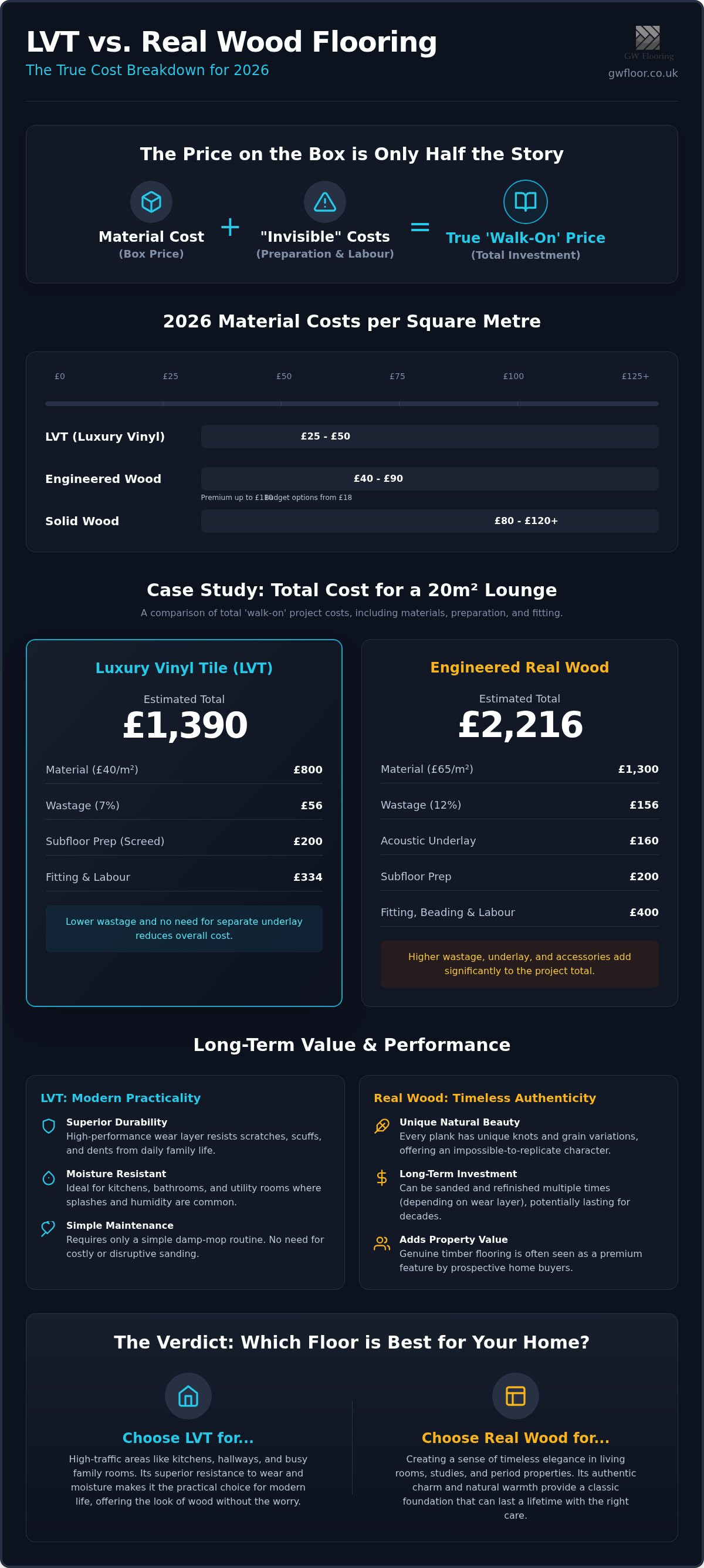
The market for timber varies wildly. Based on 2026 data, solid hardwood supply costs often start at £80 per m², whilst engineered wood offers a broader range. Budget engineered planks can be found for £18 to £32 per m², but premium options with thicker wear layers can reach up to £110 per m². These prices reflect the rarity of the wood species and the thickness of the top timber layer.
In contrast, LVT pricing is dictated by the thickness of the wear layer and the complexity of the design, such as intricate herringbone patterns. At GW Flooring, we've found that focusing solely on the "material only" price is a mistake. A cheap engineered wood might look good in the box, but if it only has a 2mm wear layer, it can only be sanded once. A high-end LVT won't need sanding at all. We always encourage our clients in Essex to look at the "walk-on" price. The initial material cost is just one part of the foundational work required for a lasting finish.
Comparing Total Project Costs: The 2026 Price Breakdown
Calculating the cost of LVT vs real wood flooring UK involves much more than simply multiplying the room's square metreage by the box price. For a standard 20sqm lounge in Rayleigh, the total "walk-on" price includes several variables that often surprise homeowners. Real wood planks are natural products, which means they come with inherent knots or colour variations that may not suit your layout. Consequently, we always recommend a wastage margin of 10-15% for timber. In contrast, the uniform nature of LVT allows for a much tighter 5-7% wastage, meaning you pay for less material that ends up in the skip.
Average Material Costs per Square Metre
In 2026, material prices reflect the global demand for high-quality sustainable products. Quality LVT brands generally range from £25 to £50 per sqm, providing a durable surface that mimics premium timber. If you prefer the authentic feel of real wood, engineered planks with decent veneers typically sit between £40 and £90 per sqm. For those seeking the prestige of solid wood, premium species can easily exceed £120 per sqm. When you consider the long-term value of LVT vs real wood, the initial material spend is only the first chapter of the story. If you're unsure which material suits your home's layout, we can help you organise a professional assessment where we bring samples directly to your door.
Wastage and Accessory Expenses
Accessories can add a significant percentage to your final bill. Real wood requires an expansion gap around the perimeter to allow the timber to breathe, which necessitates the purchase of matching beading or scotias. You'll also need to factor in the cost of specialist underlay, which can range from £5 to £12 per sqm depending on the acoustic properties required. Many LVT products now feature built-in acoustic backing, which simplifies the process and reduces the need for separate rolls of underlay.
The "invisible" costs also extend to the transition between rooms. Matching door bars, radiator pipe covers, and specialist adhesives are essential for a professional finish. LVT often wins on versatility here, as it can be fitted flush against skirting boards in many scenarios, providing a sleeker, more modern aesthetic. Whilst a pack of timber might seem comparable in price to a pack of luxury vinyl, the cumulative cost of these accessories often makes LVT the more budget-friendly option for a total project transformation.
The Invisible Costs: Subfloor Preparation and Fitting
Many retailers suggest that modern flooring is a simple weekend DIY project. This is often misleading. Whilst the top layer provides the aesthetic, the work beneath the surface dictates how long that beauty lasts. When calculating the cost of LVT vs real wood flooring UK, the condition of your existing subfloor is the single biggest variable. Professional subfloor preparation is the foundation of any 20-year floor.
Why Subfloor Preparation is Non-Negotiable
Luxury Vinyl Tiles are relatively thin and flexible. If your concrete floor has tiny grit pieces, slight dips, or ridges, these imperfections will eventually "telegraph" through to the surface of the LVT. This creates unsightly bumps and can even cause the tiles to unbond. To prevent this, we use professional screeding. This involves applying a smoothing compound to create a mirror-smooth, level finish. On timber subfloors, we install 6mm or 9mm flooring-grade plywood. We find that 9mm ply is often the better choice for older Essex homes with slightly uneven joists, as it provides superior rigidity. Real wood, particularly engineered planks, is much thicker and can sometimes bridge minor imperfections that would cause LVT to fail. Adhering to the standards set by The Contract Flooring Association ensures that moisture levels and surface regularity are perfect before a single tile or plank is laid.
Professional Fitting Rates in Rayleigh and Essex
Labour rates in the South East for 2026 reflect the high level of craftsmanship required for a premium finish. Fitting real wood is a labour-intensive process. It involves heavy lifting, complex cuts around door frames, and the careful management of expansion gaps. Consequently, fitting costs for engineered wood generally range from £15 to £25 per m², whilst solid hardwood can rise to £60 per m² due to the technical nature of secret-nailing or full-bond sticking.
- Click LVT: Faster to install but still requires a perfect subfloor.
- Glue-down LVT: Requires a specialist to apply adhesive correctly and align intricate patterns like herringbone.
- Real Wood: The slowest installation due to material acclimatisation and complex perimeter finishing.
We've encountered many homeowners who chose "cheap" fitting only to face expensive repairs eighteen months later when the floor began to lift or creak. A seasoned craftsman doesn't just lay the floor; they manage the technical groundwork that protects your investment. Choosing a specialist who understands the specific challenges of Rayleigh’s varied housing stock ensures your floor remains a point of pride for decades.
Long-Term Value: Maintenance and Durability Costs
A floor's true price isn't settled on the day of installation. When evaluating the cost of LVT vs real wood flooring UK, you must consider the "cost-per-year" over the next two decades. Real wood is a prestigious choice, but it requires a disciplined maintenance schedule. To keep timber looking its best, most professionals recommend sanding and resealing every 5 to 7 years. While specialists like Restore-A-Floor can provide these expert services, it remains a disruptive and expensive process that adds thousands to the lifetime cost of the floor. LVT, by comparison, offers a zero-maintenance profile. A damp mop and occasional sweep are usually the only requirements to keep a high-end vinyl floor looking brand new.
Moisture resistance is another critical factor for the long-term budget. A minor plumbing leak in a kitchen or a splash from a bath can cause real wood planks to cup or warp almost instantly. This often leads to a full floor replacement. Because LVT is entirely waterproof, it provides a financial safety net. This durability is reflected in the manufacturer's confidence; whilst many wood products carry a 10-year limited warranty, premium LVT brands frequently offer 25 years or even lifetime domestic guarantees.
Durability in High-Traffic UK Households
Busy Rayleigh households with pets and children often find that LVT is the more practical investment. Real wood, particularly softer species or budget engineered planks with thin veneers, is susceptible to scratches from dog claws and indentations from high heels. Modern LVT features a hardened wear layer designed to resist these daily stresses. Additionally, LVT offers superior UV stability. Whilst real wood can fade or change colour significantly when exposed to sunlight in a conservatory, premium vinyl maintains its original hue for much longer. If a disaster does happen, replacing a single damaged LVT tile is a straightforward task, whereas replacing a single wood board often involves lifting large sections of the floor.
Underfloor Heating Efficiency
Energy efficiency is a major factor for modern UK renovations. LVT has excellent thermal conductivity, which means heat from an underfloor system passes into the room quickly and evenly. This reduces the strain on your boiler and can lead to lower energy bills over time. Real wood is a natural insulator. It's much thicker and denser, which creates a barrier that slows down heat transfer. There is also a technical risk with timber. Constant temperature fluctuations can cause real wood to shrink or develop unsightly gaps between the planks. LVT is engineered to be dimensionally stable, making it the safer partner for underfloor heating. To see how these materials look in your own light, you can book a home sample visit where we bring the showroom directly to you.
The Verdict: Which Floor is Best for Your Essex Home?
Choosing between these two premium materials ultimately comes down to the rhythm of your household and the architectural character of your property. Whilst the cost of LVT vs real wood flooring UK is a significant factor, the best value is always found in a floor that thrives in its specific environment. Real wood remains a beautiful choice for formal dining rooms or period properties in Rayleigh where prestige and authenticity are the priority. However, for the modern, high-traffic family home, the resilience and waterproof nature of luxury vinyl are difficult to beat.
Making Your Decision Based on Room Usage
Your room's specific challenges should dictate your material choice. In Rayleigh kitchens and open-plan living areas, LVT is the stress-free alternative. It handles dropped pans, muddy paws, and juice spills without staining or denting. For bathrooms, we exclusively recommend LVT; the high moisture levels in these spaces will cause real wood to fail prematurely. If you're renovating a formal space with lower footfall, engineered wood provides that unmistakable organic warmth that still adds significant resale value to Essex homes.
Next Steps: Getting an Accurate Quote
Generic online estimators often fail to account for the unique subfloor requirements of local Essex properties. A standard price-per-metre quote can't tell you if your concrete base needs a damp-proof membrane or if your floorboards require a specific grade of plyboarding. We believe the only way to provide an honest, fixed price is through a professional site survey. This includes a crucial moisture test to ensure your new floor won't be compromised by rising dampness from beneath the surface.
To help you visualise the transformation, we bring the entire showroom experience to your front door. Seeing samples in your own home's unique lighting is the only way to be certain of your colour and texture choice. We invite you to book a free home consultation with GW Flooring today. We'll assess your subfloor, discuss your design vision, and provide a clear, "walk-on" price that includes every essential step of the installation process. By focusing on the foundational groundwork first, we ensure your chosen floor remains a point of pride for your family for decades to come.
Transform Your Essex Home with Confidence
Choosing the right material is only half the battle. As we have explored, the true cost of LVT vs real wood flooring UK depends heavily on the "invisible" work beneath the surface. Whilst real wood offers timeless prestige, LVT provides a durable, waterproof, and low-maintenance alternative that often delivers better long-term value for busy households. The key to a floor that lasts twenty years isn't just the brand you buy; it is the meticulous subfloor preparation and expert installation that happens before the first tile is laid.
With over 20 years of family-run expertise across Rayleigh and Basildon, we take pride in managing every technical detail so you don't have to. We believe you should see your chosen floor in your own home's unique lighting before making a final decision. Book your free "Showroom to You" home visit in Rayleigh or Essex today to receive a precise, all-inclusive quote. We are ready to help you realise your vision with a flawless, professional finish that will stand the test of time and the chaos of daily life.
Frequently Asked Questions
Is LVT cheaper than engineered wood in the UK?
LVT is usually more cost-effective than engineered wood when you factor in the total project spend. Whilst the per-metre material price can sometimes be similar for premium vinyl and budget timber, the lower wastage rates and faster installation times of LVT reduce the overall bill. You also save on the recurring costs of professional sanding and resealing that real wood demands every few years to maintain its appearance.
Does LVT increase the resale value of a UK home as much as real wood?
Real wood traditionally carries more prestige in period properties, but high-end LVT brands like Amtico and Karndean are now viewed as a premium asset by UK homebuyers. Buyers often value the immediate practicality of a waterproof, scratch-resistant floor in kitchens and hallways. In modern Essex developments, a professionally installed LVT floor can be just as attractive to a surveyor as engineered timber, provided the subfloor preparation is flawless.
Can I install LVT over my existing floor to save on costs?
We strongly advise against installing LVT over existing floors like old tiles or floorboards to save money. Any slight movement, grout line, or imperfection in the old surface will eventually "telegraph" through the thin vinyl, ruining the finish. To achieve a professional result, the existing floor should be removed so that we can apply the correct smoothing compound or flooring-grade plywood, ensuring your new investment doesn't fail prematurely.
How much does professional floor fitting cost per square metre in Essex?
Fitting rates in the South East for 2026 are influenced by the technical skill required for the job. Simple click-system installations are generally more affordable than complex glue-down patterns like herringbone. When calculating the cost of LVT vs real wood flooring UK, remember that labour costs also cover the specialist tools, adhesives, and moisture testing equipment that a professional craftsman uses to guarantee a high-quality, long-lasting finish for your home.
Which flooring is better for dogs: LVT or real hardwood?
LVT is significantly better for households with dogs. Real hardwood is a porous material that can be easily scratched by claws and permanently stained by "accidents" or wet paws. Modern luxury vinyl tiles feature a hardened, slip-resistant wear layer that resists these daily stresses. It's also much easier to clean; a quick damp mop is all that's needed to remove muddy footprints without damaging the floor's structural integrity.
Is LVT or real wood better for underfloor heating systems?
LVT is the superior partner for underfloor heating because it has much higher thermal conductivity. It allows heat to transfer into the room quickly and efficiently, which helps to keep your energy bills lower. Real wood acts as a natural insulator, creating a barrier that slows down the heating process. Timber also carries the risk of shrinking or gapping when exposed to the constant temperature changes of an underfloor system.
What is the average lifespan of LVT compared to real wood?
Real wood can technically last for a century if it is meticulously maintained and sanded every decade. However, LVT is designed to look pristine for 25 to 35 years with almost no maintenance. For most busy Rayleigh families, the "practical lifespan" of LVT is often higher. It doesn't suffer from the fading, warping, or deep scratching that can make a real wood floor look tired and worn after just a few years.
Why is subfloor preparation so expensive for LVT floors?
Subfloor preparation is an investment in the "invisible" quality of your floor. The materials used, such as fibre-reinforced smoothing compounds and 9mm flooring-grade plywood, are premium technical products designed to create a perfectly level base. This meticulous process takes time and skill to execute correctly. Without this foundational groundwork, even the most expensive LVT will eventually lift or show imperfections, leading to much more costly repairs in the future.


