
The cheapest floor in the room is rarely the most affordable one in the long run. That's the uncomfortable truth many Essex homeowners discover after their laminate starts lifting in the kitchen or buckling near the back door. When you're weighing up LVT vs laminate, the price tag on the box tells only half the story; the other half is written in replacement costs, failed DIY fits, and subfloors that were never properly prepared in the first place.
If you've found yourself wondering whether LVT is genuinely worth the extra investment over a high-quality laminate, you're asking exactly the right question. It's one we hear constantly across Essex, and the honest answer isn't as straightforward as most comparison guides would have you believe.
In this guide, we'll cut through the confusion around waterproofing, installation methods, and those hidden costs that rarely make it into the brochure. By the end, you'll have a clear, confident picture of which flooring suits your home, your lifestyle, and your long-term plans for the property.
Key Takeaways
- The true cost of flooring extends well beyond the price per square metre — understanding the long-term performance of each option is essential before committing to either product.
- When comparing LVT vs laminate, water resistance is the single most decisive factor for kitchens, bathrooms, and open-plan spaces where moisture is a daily reality.
- Subfloor preparation is the invisible difference between a floor that lasts decades and one that fails within years — and it's a step that DIY installations routinely get wrong.
- Visual realism has advanced significantly in both product types, but premium LVT ranges use registered embossing technology to achieve a level of authenticity that flat photographic laminates simply cannot match.
- There is no single winner — the right choice depends on your room, your household, and your long-term plans for the property, and this guide will help you identify exactly which option suits your Essex home.
What is the Difference Between LVT and Laminate Flooring?
At first glance, LVT and laminate can look almost identical on a showroom floor. Both mimic the appearance of natural timber. Both come in click-lock formats. Both are positioned as practical alternatives to solid wood. But beneath the surface, these two products are built from entirely different materials, behave in completely different ways, and suit very different homes. Understanding that distinction is the foundation of any honest LVT vs laminate comparison.
The Anatomy of a Laminate Plank
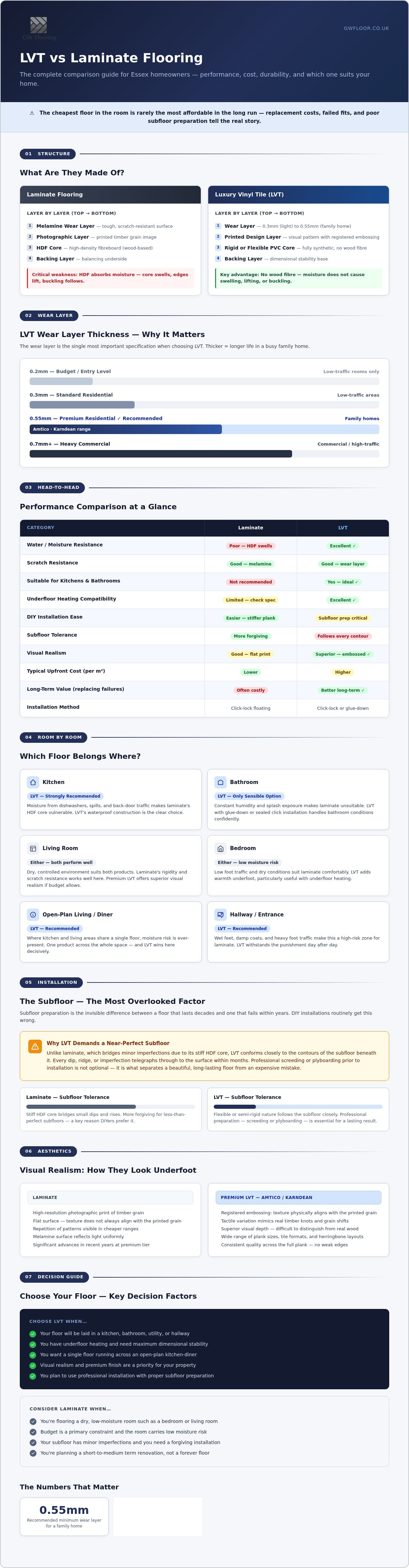
Laminate is, at its core, a wood-based product. A standard plank is constructed from a High-Density Fibreboard (HDF) core, which is compressed wood fibres bonded under heat and pressure. On top of that sits a photographic layer, a high-resolution image of timber grain printed onto paper, which is then sealed beneath a melamine wear layer.
That melamine surface is genuinely tough. It resists scratches well, which is part of why laminate has long been the favourite for busy family rooms. The HDF core also provides a satisfying rigidity underfoot; because the plank is relatively thick and stiff, it bridges minor imperfections in the subfloor rather than following every dip and rise. This structural quality makes it forgiving during installation, which is precisely why DIY enthusiasts have gravitated towards it for decades.
The critical weakness, however, is that HDF is a wood-derived product. It absorbs moisture. Expose the core to standing water, whether from a spill, a leaking appliance, or a damp subfloor, and the fibres begin to swell. That swelling causes the familiar edge-lifting and buckling that so many Essex homeowners have experienced firsthand.
The Structure of Luxury Vinyl Tiles
LVT is built entirely differently. There's no wood fibre involved. A quality LVT plank is a multi-layered synthetic construction, typically comprising:
- A backing layer for dimensional stability
- A rigid or flexible PVC core that forms the structural body of the plank
- A printed design layer carrying the visual pattern
- A wear layer that protects the surface from daily traffic
That wear layer is where specification really matters. A 0.3mm wear layer is adequate for low-traffic areas, but a 0.55mm wear layer is the standard you should be looking for in a family home. Brands such as Amtico and Karndean, both of which we supply and install across Essex, build their residential ranges with wear layers that reflect genuine long-term thinking rather than short-term cost-cutting.
Because LVT is fully synthetic, it doesn't react to moisture the way laminate does. It also conforms more closely to the contours of the subfloor rather than bridging over them, which makes thorough subfloor preparation not just advisable but essential. A professional installation, with screeding or plyboarding carried out correctly beforehand, is what separates a floor that performs beautifully for twenty years from one that telegraphs every imperfection within months.
One more myth worth addressing: not all LVT is click-lock. Whilst rigid core click systems are now dominant in the residential market, glue-down LVT remains the preferred choice for many commercial settings and for installations over underfloor heating where maximum dimensional stability is required. The right fixing method depends entirely on the specific room, the subfloor condition, and how the space will be used.
Durability and Performance: Which Floor Wins in a Busy Home?
Performance is where the real differences between these two products emerge. On paper, both offer impressive durability credentials. In practice, the gap between them depends almost entirely on where they're being laid and how the household actually lives.
The Moisture Challenge in Kitchens and Bathrooms
We've already established that HDF absorbs moisture. What's worth understanding in more detail is exactly what that failure looks like in real life. It rarely happens dramatically. Instead, it's gradual: a slight peak at the joint between two planks near the dishwasher, a gentle bow developing along the edge closest to the back door. By the time it's visible, the damage is already done and replacement is the only solution.
LVT doesn't carry that risk in the same way, but here's something most comparison guides skip over: "waterproof" describes the plank itself, not the installation. A glue-down LVT floor, properly installed with the correct adhesive and fully bonded to a prepared subfloor, creates a continuous moisture barrier. A click-lock LVT floor laid without adequate attention to the joins is still vulnerable to water tracking beneath the surface and affecting the subfloor below. The plank survives; the subfloor may not. That distinction matters enormously in Essex kitchens where older concrete subfloors can harbour residual dampness.
Pets, Children, and Daily Wear
This is one area where the LVT vs laminate conversation becomes genuinely nuanced. Laminate's melamine wear surface is rated using the AC (Abrasion Class) system, with AC3 suitable for moderate residential use and AC4 appropriate for heavy domestic traffic. A quality AC4 laminate can actually outperform budget LVT when it comes to resisting the kind of surface scratching that dog claws inflict daily.
Where LVT regains the advantage is in repairability. With a click-lock system, a single damaged plank can be lifted and replaced without disturbing the surrounding floor. Laminate can theoretically offer the same, but in practice, colour-matching an older laminate batch is notoriously difficult. Premium LVT ranges from Amtico and Karndean are manufactured with far greater batch consistency, making future repairs a far less stressful prospect.
Underfloor heating is increasingly common in new Rayleigh builds, and both materials are compatible with it, though with different tolerances. LVT, particularly glue-down formats, performs exceptionally well over UFH because it maintains dimensional stability at the temperatures typically used in residential systems. Laminate can be used over underfloor heating, but the maximum surface temperature must be carefully managed to prevent the HDF core from drying out and contracting at the joins.
Sound is another practical consideration that rarely features prominently enough. Laminate's rigid HDF core transmits impact noise readily, producing the familiar hollow click underfoot that can feel cheap regardless of how the product looks. LVT, with its denser, more compliant construction, absorbs that impact and delivers a noticeably quieter, more grounded feel. In open-plan living spaces, which are increasingly popular across Essex homes, that acoustic difference is something you notice every single day.
If you're unsure which specification suits your specific rooms and subfloor conditions, the team at GW Flooring offers a showroom-to-you service across Essex, bringing samples and honest advice directly to your home.
Visual Appeal and Comfort: Achieving the Perfect Aesthetic
Performance credentials matter, but most Essex homeowners will admit that what ultimately wins them over is how a floor looks and feels underfoot. This is where the lvt vs laminate conversation shifts from technical specification into something more personal, and where the gap between the two products becomes genuinely visible to anyone standing in the room.
Authenticity: The Look and Feel of Real Wood
Both materials have come a long way from the flat, obviously artificial finishes of a decade ago. Today's premium laminate uses high-definition photography to reproduce timber grain with impressive accuracy. But there's a ceiling to what a photographic layer can achieve, and most homeowners sense it without being able to articulate exactly why.
The reason is texture. Laminate prints the image of grain onto a flat surface, then applies a uniform embossed texture across the entire plank. Premium LVT, by contrast, uses registered embossing: a process where the surface texture is precisely aligned to the printed grain beneath it. Run your finger along a Karndean or Amtico plank and the raised grain follows the visual pattern exactly, just as it would on genuine timber. That tactile authenticity is something you simply can't replicate with a photographic layer alone.
Sound plays into this too. The previous section touched on acoustic performance, but it's worth adding here that the hollow resonance of laminate underfoot doesn't just feel cheaper; it actively undermines the impression of quality that a premium visual creates. Professionally fitted LVT delivers a dense, grounded feel that reinforces the visual realism rather than contradicting it.
Stone-effect LVT deserves a particular mention for Essex hallways. Traditional ceramic tiles are cold, hard underfoot, and unforgiving to install over older subfloors. Stone-effect LVT achieves a near-identical visual result with none of those drawbacks, and it's become one of the most requested finishes we see across Rayleigh homes.
Bespoke Patterns and Creative Layouts
One limitation that rarely features in competitor comparisons is the repetition problem. Budget laminate ranges typically use a small number of photographic repeats, meaning the same grain pattern appears every few planks across a large room. In a small utility room it goes unnoticed. In an open-plan kitchen-diner it becomes distracting once you've spotted it.
Premium LVT ranges address this directly with larger pattern libraries and randomised plank sequencing. But the real creative advantage lies in what LVT allows you to do with layout. Herringbone and chevron patterns have become increasingly popular in Rayleigh homes, and LVT's dimensional consistency makes them far more achievable than laminate, where the rigid HDF core makes precise angled cutting considerably more demanding. Feature borders and inlay strips can define zones within open-plan spaces, frame a hallway, or draw attention to a focal point in a living room. These are design moves that laminate's format simply doesn't accommodate.
If you're exploring what's possible for your own rooms, the home flooring options guide for Rayleigh covers layout ideas and design considerations in more detail.
Warmth underfoot is the final piece. LVT's composite construction retains ambient temperature more effectively than the denser HDF core of laminate, which tends to feel noticeably cooler underfoot, particularly on ground floors. It's a subtle difference, but in an Essex kitchen on a January morning, it's one you notice every single day.
The Professional Installation Perspective: Why the Subfloor Matters
There's a principle we return to on every single job across Essex: your new floor is only as good as what lies beneath it. It doesn't matter whether you've chosen a premium Amtico LVT or a high-specification laminate. If the foundation isn't right, the finished result won't be either. This is the part of the lvt vs laminate conversation that most comparison guides skip entirely, and it's the part that costs homeowners the most money when it goes wrong.
Screeding and Plyboarding Explained
The appropriate preparation method depends entirely on what your subfloor is made of. Concrete subfloors, common in ground-floor extensions and older Essex properties, typically require a liquid self-levelling screed. This compound is poured across the surface and flows into low spots, creating a flat, consistent base once cured. Timber joist subfloors, found in most suspended ground floors and upper storeys, require a different approach: plyboarding, where sheets of structural plywood are fixed firmly across the existing boards to eliminate flex, movement, and surface variation.
For LVT specifically, this preparation isn't optional. Because LVT is a compliant material that conforms to the contours beneath it rather than bridging over them, any ridge, dip, or fastener head in the subfloor will eventually telegraph through to the surface, becoming visible as a raised line or depression that worsens with foot traffic over time. A floor that looks flawless on day one can begin showing those imperfections within months if the groundwork wasn't done correctly. Our guide to professional floor installation in Rayleigh and Essex covers subfloor assessment in more detail if you'd like to understand what that process involves before booking.
Laminate's Underlay Advantage
Laminate does have one genuine advantage here. Its rigid HDF core bridges minor subfloor imperfections rather than following them, and a quality foam or fibre underlay provides an additional buffer. This is part of why DIY laminate installations succeed more often than DIY LVT ones. It's more forgiving. That said, "more forgiving" isn't the same as "forgiving of anything." Significant undulation or movement in a timber subfloor will still cause laminate joints to stress and fail over time.
Professional Fitting vs DIY Risks
Glue-down LVT requires specialist adhesives, correct trowel notch sizing, and a weighted roller passed across the entire surface after laying to ensure full bond. These aren't steps that can be improvised. Skipping the roller alone, something DIY guides rarely emphasise, can result in hollow spots that cause the plank to flex, the adhesive bond to fail, and the surface to lift at the edges. Fixing a poorly laid floor almost always costs more than having it fitted correctly in the first place, because the remedial work involves not just re-laying the product but often replacing damaged planks and repeating the subfloor preparation from scratch.
Our showroom-to-you service exists precisely to prevent this. We visit your home across Essex, assess your actual subfloor conditions, and recommend the right product and fixing method for your specific situation, not a generic answer based on what's easiest. Speak to the GW Flooring team about a home visit and we'll give you an honest assessment before any commitment is made.
Final Verdict: Choosing the Right Flooring for Your Essex Property
After working through the technical detail, the honest conclusion is this: neither product wins outright. The right answer in the lvt vs laminate debate depends on the room, the household, and how long you're planning to stay in the property. What we can do is give you a clear framework for making that decision with confidence.
Choose laminate when: you're renovating a bedroom, a study, or a low-traffic living room where moisture isn't a daily concern. It's also a sensible choice when you're preparing a property for sale and need to maximise visual impact without committing to a long-term investment. A quality AC4 laminate, professionally fitted with the right underlay, delivers excellent results in the right context.
Choose LVT when: you're laying a kitchen, bathroom, hallway, or open-plan living space. Choose it when you have pets, young children, or underfloor heating. Choose it when you want a floor that genuinely performs for fifteen to twenty years without the anxiety of a single spilled glass of water undoing everything.
The total cost of ownership calculation almost always favours LVT in high-traffic or moisture-prone rooms. A laminate that fails in a kitchen after five years and requires full replacement, including subfloor remediation, costs considerably more than the premium LVT that was never laid in the first place. That's not a theoretical scenario; it's one we encounter regularly across Essex properties.
Room-by-Room Recommendation Summary
Busy hallways with muddy paws coming in from the garden: LVT, without hesitation. The combination of moisture resistance, ease of cleaning, and surface durability makes it the only sensible choice for that kind of daily punishment. Open-plan kitchen-diners, which have become the defining feature of modern Essex homes, benefit from LVT's design flexibility, its acoustic qualities, and its ability to carry a consistent aesthetic across zones that experience very different conditions. For bedrooms and formal reception rooms, a premium laminate is a perfectly legitimate choice that needn't compromise on appearance or longevity. Our complete guide to LVT flooring installation in Essex covers specification decisions in more detail if you're ready to move forward with that option.
Next Steps for Your Flooring Project
The single most useful thing you can do before committing to either product is have someone assess your actual subfloor conditions. Samples look different in your own light, against your walls, with your furniture. What works in a showroom doesn't always translate to a north-facing hallway in Wickford or a ground-floor extension in Basildon.
Before signing any quote, ask your contractor three things: how they intend to prepare the subfloor, which fixing method they're recommending and why, and what happens if a plank needs replacing in five years' time. The answers will tell you a great deal about the quality of what you're about to receive.
We bring samples directly to homes across Rayleigh, Wickford, and Basildon, assess your subfloor honestly, and give you a clear recommendation without any obligation to proceed. Contact GW Flooring to arrange a professional consultation and take the guesswork out of one of the most important decisions you'll make for your home.
Make Your Flooring Decision With Confidence
The lvt vs laminate debate doesn't have a single winner, and any guide that tells you otherwise is oversimplifying. What this article has shown is that the right choice comes down to your specific rooms, your household, and how seriously the installation is approached from the subfloor upwards.
Three things are worth carrying forward. First, moisture-prone rooms deserve LVT, full stop. Second, subfloor preparation determines whether any floor succeeds or fails, regardless of what you spend on the product itself. Third, premium brands like Amtico and Karndean exist in a different category from budget vinyl, and that difference shows up years down the line.
With over 20 years of family-run expertise in Rayleigh, GW Flooring brings that knowledge directly to your door. We're specialists in subfloor preparation and expert installers of Amtico and Karndean luxury vinyl, and we'll give you an honest recommendation before you commit to anything.
Book your Showroom to You home visit across Essex today and take the first step towards a floor you'll love for decades to come.
Frequently Asked Questions About LVT vs Laminate
Is LVT more expensive than laminate?
Generally, yes. Premium LVT from brands like Amtico and Karndean carries a higher upfront cost per square metre than a comparable quality laminate. However, the total cost of ownership often tells a different story. A laminate that requires replacement after five years in a moisture-prone room will cost considerably more overall than LVT that performs reliably for fifteen to twenty years without incident.
Subfloor preparation adds to the initial outlay for both products, but it's a one-time investment that protects everything laid on top of it. Getting that groundwork right from the start is always cheaper than remedial work later.
Can I lay LVT over my existing laminate floor?
We'd strongly advise against it. Laminate surfaces aren't dimensionally stable enough to serve as a subfloor for LVT, and any existing movement, swelling, or joint separation in the laminate will telegraph directly through to your new floor within months. The correct approach is to remove the existing laminate, assess the subfloor beneath, and carry out any necessary preparation before laying LVT.
This is particularly important for glue-down LVT, which requires a clean, flat, fully bonded surface to achieve proper adhesion. Cutting corners at this stage is one of the most common reasons we're called in to remediate floors that have failed prematurely.
Which is better for underfloor heating, LVT or laminate?
LVT is the stronger performer over underfloor heating, particularly in glue-down format. Its synthetic construction maintains dimensional stability at the temperatures used in residential UFH systems, and it conducts heat efficiently without the risk of the material contracting at the joins. Glue-down LVT also creates the closest possible contact between the plank and the heated subfloor, maximising thermal efficiency.
Laminate can be used with underfloor heating, but it requires careful temperature management. If the surface temperature exceeds the manufacturer's recommended maximum, the HDF core can dry out and shrink, causing gaps to open at the joints. Always check the specific product's UFH compatibility rating before committing.
Does LVT increase the value of my home more than laminate?
Premium LVT from recognised brands tends to be viewed more favourably by buyers and valuers, particularly in kitchens, bathrooms, and open-plan spaces where durability is a clear selling point. Its association with quality and longevity can contribute positively to perceived property value, especially when professionally installed with visible attention to detail in the finish.
Laminate in good condition in appropriate rooms, such as bedrooms or a home office, is unlikely to detract from a sale. The real risk is laminate in the wrong location: a kitchen with lifting edges near the dishwasher is a red flag for buyers and can actively undermine confidence in the property's overall condition.
How long does professional LVT installation take compared to laminate?
Both products can typically be laid across an average-sized room in a single day once the subfloor preparation is complete. The preparation itself is where timelines differ. Liquid self-levelling screed requires a curing period before LVT can be laid on top, which may extend the overall project by a day or two depending on conditions. Plyboarding over a timber subfloor is faster and allows installation to proceed more quickly.
Laminate installation is generally quicker overall because its rigid HDF core is more forgiving of minor subfloor variation, reducing the preparation time required. That said, rushing subfloor preparation to save a day is a false economy regardless of which product you're laying.
Is laminate flooring still fashionable in 2026?
In the right rooms, absolutely. Premium laminate in wide-plank formats with realistic grain textures remains a popular and visually credible choice for bedrooms, studies, and formal living spaces. The product has evolved considerably, and today's high-specification ranges look far removed from the flat, obviously synthetic finishes of earlier generations.
Where laminate has lost ground is in open-plan and wet-adjacent spaces, where homeowners have increasingly recognised the practical limitations. For those areas, LVT has become the default expectation rather than the premium upgrade, and that shift reflects genuine experience with real-world performance rather than simply following trends.
What is the best way to clean LVT vs laminate?
LVT is straightforward to maintain. Regular sweeping or vacuuming removes surface debris, and a damp mop with a pH-neutral cleaner is all that's needed for a thorough clean. Because the surface is fully synthetic, it tolerates moisture without any risk of damage, making it genuinely low-maintenance in busy kitchens and hallways.
Laminate requires a more cautious approach. Excess water is the enemy, so a well-wrung, lightly damp mop is essential rather than a wet one. Avoid steam mops entirely on laminate; the heat and moisture combination can cause the HDF core to swell and the surface layer to lift at the edges. Dry spills immediately, particularly near joins, to prevent moisture tracking beneath the planks.
Do I need underlay for LVT flooring?
It depends on the product and the fixing method. Click-lock LVT often incorporates a pre-attached underlay layer, which provides cushioning and a modest acoustic benefit. Some installations benefit from a separate thin underlay, though this must be compatible with the specific product and subfloor type. Always follow the manufacturer's guidance, as using the wrong underlay can actually void the product warranty.
Glue-down LVT is laid directly onto the prepared subfloor with no underlay at all. The adhesive bond provides the stability, and adding any cushioning layer between the plank and the subfloor would compromise that bond. This is one of the reasons professional assessment of your specific subfloor conditions matters so much before any product decision is made.


