

The biggest mistake you can make with timber is trying to clone it. When choosing flooring that matches oak furniture, hunting for an identical wood grain almost always results in an unflattering "near-miss" where competing undertones clash under your living room lights. If you have spent weeks staring at carpet swatches and vinyl samples, terrified of turning your home into a flat, monochromatic wood-box, you are certainly not alone.
Every homeowner wants their dining table, sideboard, or heirloom cabinets to sit naturally within their space rather than fight against the floor. We know how overwhelming it feels to decipher whether your pieces carry subtle pink, amber, olive, or golden hues. This guide shows you how to balance those tricky undertones, select purposeful contrasts, and choose the ideal floor covering, from luxury vinyl tiles like Amtico and Karndean to textured wool carpets, without the trial-and-error headaches.
Read on to master our practical framework for identifying your furniture's true base colours, testing physical samples under real lighting, and creating a cohesive, elegant interior you will love for years to come.
Key Takeaways
- Avoid the temptation to match timber grains identically; master the art of choosing flooring that matches oak furniture by balancing warm, cool, and neutral undertones instead.
- Apply the two-shade contrast rule to create clear visual separation, pairing rich golden oak dining sets with lighter tones or deeper, grounding foundations.
- Discover why modern Luxury Vinyl Tiles (such as Amtico and Karndean) and textured carpets deliver superior dimensional stability and lower maintenance compared to solid wood.
- Follow our simple five-step sampling framework to evaluate large-format planks and tiles directly alongside your furniture under changing home lighting conditions.
- Learn why invisible foundational groundwork, from screeding concrete to plyboarding timber subfloors, is the vital secret to a flawless, long-lasting aesthetic finish.
Decoding Oak Undertones: Why Matching Furniture to Flooring Goes Wrong
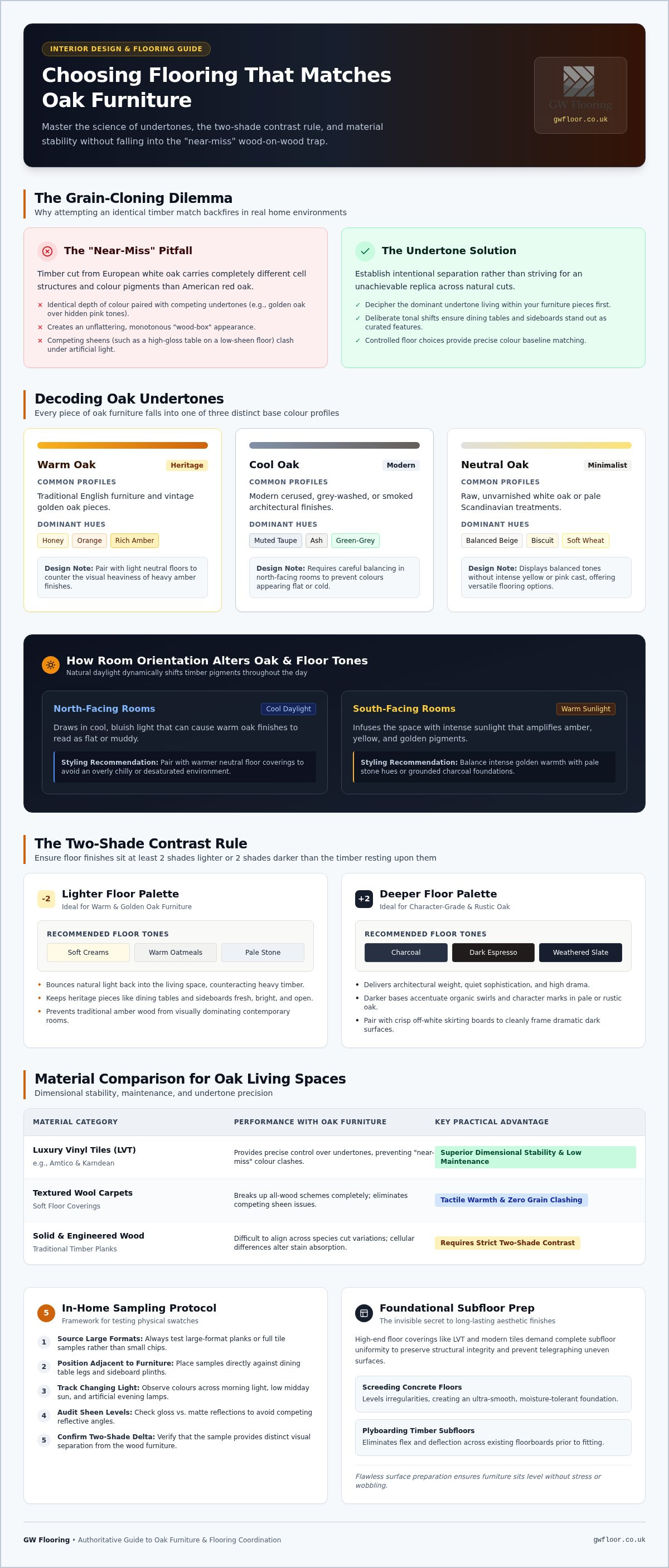
Homeowners often assume the safest path is buying flooring that mirrors their dining table. In practice, this strategy backfires. Natural oak is remarkably complex; timber cut from European white oak carries completely different cell structures and colour pigments than American red oak. When choosing flooring that matches oak furniture, attempting an exact timber match creates a jarring, flat aesthetic because the subtle base pigments rarely align.
Natural lighting changes these dynamics further throughout the day. North-facing rooms draw in cool, bluish light that can turn warm finishes muddy, whereas south-facing sunlight intensifies amber and yellow pigments. To build authentic interior cohesion rather than a monotonous wood box, you must first decipher the dominant undertone living within your furniture.
Identifying Warm, Cool, and Neutral Oak Finishes
Every oak piece falls into one of three distinct colour profiles:
- Warm Oak: Typical of traditional English furniture and vintage golden oak, displaying distinct honey, orange, or rich amber hues.
- Cool Oak: Often seen in modern cerused, grey-washed, or smoked finishes, featuring muted taupe, ash, or subtle green-grey undertones.
- Neutral Oak: Characterised by raw, unvarnished white oak or pale Scandinavian treatments, displaying balanced beige, biscuit, and soft wheat tones without yellow or pink cast.
The Near-Miss Trap of Wood-on-Wood Styling
The "near-miss" occurs when your floor covering and furniture share an identical depth of colour but feature conflicting undertones. For instance, resting a golden-honey oak sideboard over a floor with hidden salmon or pink pigments draws immediate attention to the discrepancy. While traditional engineered and solid wood flooring can be difficult to balance against diverse furniture finishes, modern alternatives give you precise control over undertones.
Sheen discrepancies amplify this visual conflict. A high-gloss dining table placed across a low-sheen floor creates competing reflective planes that pull the eye downward. Instead of striving for an unachievable replica, successful interior design establishes intentional separation. Deliberate tonal shifts ensure your prized dining pieces stand out as curated features rather than blending awkwardly into the background.
The Golden Rules of Contrast: Light, Dark, and Complementary Palettes
A simple two-shade rule solves most timber styling dilemmas. When choosing flooring that matches oak furniture, ensure your floor finish sits at least two shades lighter or two shades darker than the timber resting upon it. This intentional contrast creates crisp visual separation, allowing each piece of furniture to register as an individual design element rather than dissolving into the floorboards.
Density and grain patterns dictate how distinct that contrast feels. Research published in the USDA Forest Products Laboratory wood handbook outlines the vast cellular and structural variance across oak species, which explains why identical stains read differently across various cuts of wood. By stepping away from matching grain lines, you introduce natural depth and effortless balance to the room.
Lighter Floors for Warm and Golden Oak Furniture
Pairing heavy honey-oak sideboards or traditional dining sets with light floor coverings brings an immediate sense of modern balance. Soft creams, warm oatmeals, and pale stone hues bounce natural light back into the living space, counteracting the visual heaviness of amber timber. This technique prevents heritage furniture from overwhelming contemporary rooms, keeping the entire scheme fresh, bright, and open.
Creating Drama with Dark Floors and Rustic Oak
Deeper palettes deliver architectural weight and quiet sophistication. Pairing knotty, character-grade oak tables with deep charcoal, dark espresso, or weathered slate finishes establishes a commanding focal point:
- Emphasise the grain: Darker floor bases highlight the organic swirls and character marks of pale or rustic oak furniture.
- Brighten the perimeter: Crisp off-white skirting boards help frame dramatic dark flooring and prevent rooms from feeling closed in.
- Layer the lighting: Adequate ambient and low-level task lamps ensure deep tones retain warmth during evening hours.
Breaking Up Timber with Neutral and Stone Textures
Open-plan living areas easily fall victim to timber fatigue when wooden dining sets, coffee tables, and kitchen cabinets all occupy the same unbroken view. Introducing mineral aesthetics breaks the cycle. Luxury vinyl tiles mimicking cool limestone, soft poured concrete, or tactile slate create a neutral architectural canvas that makes oak cabinetry pop. Integrating delicate design strips or borders can also frame a specific dining layout, giving the area purpose. To see how these mineral textures sit against your furniture under everyday domestic lighting, explore samples through our personalised home consultation at gwfloor.co.uk.
Evaluating the Best Flooring Materials to Complement Oak Furniture
Solid timber carries romantic appeal, but it comes with real challenges. Natural wood expands and contracts with shifting indoor humidity, requiring strict moisture controls and frequent refinishing. When choosing flooring that matches oak furniture, modern homeowners increasingly turn to alternative floor coverings that deliver the organic texture of timber without its structural vulnerabilities or high-maintenance upkeep.
While resources like Bob Vila's guide to types of hardwood flooring highlight how species density and lumber cuts affect durability, non-timber options provide far greater aesthetic flexibility. Luxury Vinyl Tiles (LVT), plush wool carpets, and high-performance sheet vinyl allow you to curate the exact colour, pattern, and texture needed to flatter your oak dining suites, beds, and sideboards.
Luxury Vinyl Tiles: Amtico, Karndean, and Authentic Textures
Luxury Vinyl Tiles represent the pinnacle of design freedom beneath heavy timber furnishings. Premium manufacturers like Amtico and Karndean utilise embossed-in-register printing technology to replicate the intricate knots, saw marks, and grain textures of natural wood. The result is total dimensional stability, meaning no seasonal gapping or moisture cupping under heavy furniture weight.
Herringbone and classic parquet layouts in pale or smoky tones elevate substantial oak tables by establishing an elegant architectural foundation. High-grade wear layers resist scuffs from dining chairs, while built-in water resistance handles accidental spills effortlessly. Discover how our professional LVT flooring installation in Essex guarantees lasting beauty across open-plan living areas.
Plush Carpets: Adding Warmth and Softness Beneath Heavy Timber
Bedrooms and formal sitting rooms often demand sensory softness to counterbalance the rigid density of oak furniture. Rich wool carpets introduce acoustic absorption and underfoot comfort that hard surfaces cannot replicate. Dense twist-pile carpets perform exceptionally well underneath heavy oak bed frames and chests, naturally resisting permanent pile crush. Light biscuit, warm greige, and heather tones create a quiet, tactile haven. Refer to our guide to professional carpet fitters in Essex for expert recommendations on underlay selection.
Durable Sheet Vinyl for Utility Spaces and Kitchens
Utility rooms and kitchen breakfast spaces require seamless moisture defence, especially where oak dressers or butcher-block islands feature. Modern cushion vinyl provides complete hygiene and effortless maintenance without sacrificing design appeal. Clean encaustic tile replicas and subtle geometric motifs introduce playful texture against plain oak cabinets, wiping clean with minimal fuss to keep busy households looking pristine year-round.
How to Test Flooring Samples in Your Home: A 5-Step Process
Tiny postal swatches rarely tell the true story. When choosing flooring that matches oak furniture, evaluating a small two-inch square against a six-foot sideboard creates blind spots that lead to costly mistakes. We recommend following a disciplined five-step assessment process right inside your living space:
- Step 1: Procure large-format samples: Source generous planks or tile tiles that capture genuine pattern repeats and authentic surface texture.
- Step 2: Position flat against furniture legs: Place samples horizontally on the subfloor directly touching the timber legs of your dining tables, dressers, and skirting boards.
- Step 3: Track shifting light conditions: Observe the pairing across morning sun, diffuse midday daylight, and evening artificial illumination.
- Step 4: Check grain scale and pattern density: Ensure bold, knotty oak furniture is counterbalanced by quieter floor patterns, or vice versa.
- Step 5: Test everyday practicality: Walk on the samples barefoot, check for dust visibility, and evaluate maintenance demands against your household routine.
Evaluating Natural and Artificial Light Variations
Window orientation alters how colours behave inside your home. North-facing rooms receive cool, bluish light that can make warm floor swatches appear dull or accentuate blue-grey undertones. South-facing spaces receive golden daylight that visibly enriches amber oak. Under evening domestic lighting, standard 2700K warm-white bulbs introduce heavy yellow casts. Check your samples beneath these bulbs to verify that warm undertones remain harmonious after dark.
Assessing Grain Scale and Board Proportions
Pattern scale determines whether a room feels calm or chaotic. When your furniture features heavy cathedral graining and prominent rustic knots, pair it with subtle, fine-grained floor designs to avoid visual clutter. In compact dining areas, wider planks and large-format luxury vinyl tiles reduce joint lines to create an expansive feel. Laying planks parallel to your primary natural light source also lets incoming sun catch surface embossing beautifully.
Viewing Samples in Situ with Mobile Showrooms
Bright showroom lighting under commercial fluorescent tubes distorts colour temperature completely. Swatches that appear neutral in a retail warehouse often reveal clashing undertones once brought through your front door. With GW Flooring's bespoke mobile showroom service, we bring hundreds of full-sized LVT, carpet, and vinyl samples directly to your doorstep across Rayleigh and wider Essex. Eliminate guesswork entirely by reviewing realistic materials against your furnishings; book your home selection visit at gwfloor.co.uk today.
Foundational Preparation: Ensuring Flawless, Long-Lasting Results
A stunning floor covering is only as dependable as the base beneath it. While choosing flooring that matches oak furniture occupies most design conversations, the invisible groundwork determines whether those luxury planks or carpets stay pristine. Solid oak sideboards, heavy extending dining tables, and display cabinets place tremendous point-load pressure on floor surfaces. Without meticulous subfloor preparation, minor dips, trowel ridges, or loose timber boards will telegraph straight through luxury finishes, creating unsightly ripples beneath your prized furniture.
Subfloors require rigorous mechanical levelling and moisture management before installation begins. For concrete slabs, applying a damp-proof membrane followed by an engineered smoothing compound creates a glass-flat foundation. Over traditional timber joists, installing flooring-grade plywood panels eliminates flex and movement. Taking these precautions protects your investment against premature wear, uneven joints, and localized indentations.
Subfloor Screeding and Plyboarding Essentials
Telegraphing is the primary enemy of glue-down luxury vinyl tiles. When light washes across an LVT installation, even a two-millimetre bump in the concrete substrate casts noticeable shadows. Meticulous preparation eliminates this risk completely:
- Concrete substrates: Professional application of self-smoothing screeds creates a level, non-porous bed that bonds securely with modern adhesives.
- Timber floorboards: Cross-layering marine-grade or SP101 plyboards secures suspended floorboards, stopping squeaks and removing joint ridges.
- Moisture suppression: Liquid damp-proof membranes seal residual construction moisture, keeping adhesive bonds rock-solid for decades.
Review the essential guide to professional floor installation to understand the full technical criteria for substrate preparation.
Protecting Your Investment with Professional Installation
Precision craftsmanship turns quality materials into timeless interiors. Scribing luxury vinyl planks around intricate oak architraves, hearthstones, and skirting requires experienced hands and sharp attention to detail. Our Rayleigh-based installation team brings over 20 years of dedicated subfloor preparation and fitting expertise straight to Essex homes. We take immense pride in handling the unseen foundation work that guarantees a seamless, durable result.
Whether you prefer wood-effect Amtico herringbone or plush wool carpets, our independent, family-run team is here to guide your renovation from start to finish. Explore diverse design inspirations in our home flooring options in Rayleigh overview. When you are ready to evaluate textures right against your furniture legs, book a free home consultation with GW Flooring and let us bring our full mobile showroom directly to you.
Bring Harmony and Lasting Quality to Your Living Space
Creating an inviting, cohesive interior starts with celebrating the natural character of timber rather than trying to replicate it. When choosing flooring that matches oak furniture, remember that deliberate contrast, accurate undertone evaluation, and meticulous subfloor groundwork make all the difference. Whether you opt for authentic wood-effect Karndean herringbone, cool limestone LVT, or a plush wool carpet, thoughtful material pairings will elevate your furniture into standout architectural features.
You don't have to navigate lighting variables or swatch selections alone. With over 20 years of dedicated subfloor preparation and fitting expertise across Essex, our family-run team takes genuine pride in getting every fine detail right. As approved installers of premium brands like Amtico and Karndean, we make the entire selection process effortless by bringing our extensive sample ranges straight into your living room. Take the guesswork out of your renovation and book your free home consultation with GW Flooring today to create a home that feels effortlessly balanced, elegant, and built to last.
Frequently Asked Questions
Can you put wood-effect LVT flooring with solid oak furniture?
Yes, you can pair wood-effect Luxury Vinyl Tiles with solid oak furniture provided you establish intentional tonal contrast rather than attempting an identical timber match. Premium brands like Amtico and Karndean replicate realistic grain textures while offering superior dimensional stability. Selecting a floor shade at least two steps lighter or darker than your dining set ensures your furniture maintains a crisp, distinct outline against the floor.
Should my flooring be lighter or darker than my oak dining table?
Either direction works exceptionally well as long as you establish clear separation. Lighter floor coverings, such as pale limestone-effect LVT or warm oatmeal wool carpets, bounce natural light across the room and stop heavy amber oak from dominating the space. Deeper floors, including weathered slate or rich charcoal planks, create striking architectural drama that grounds pale and rustic oak dining tables beautifully.
What carpet colours pair best with traditional golden oak furniture?
Warm neutrals, soft greiges, and muted earthy tones like dusty sage or stone pair best with golden oak. Traditional honey-finished timber carries pronounced orange and amber pigments that can appear brassy against yellow-cream carpets. Neutral wool carpets with subtle biscuit or heather flecks balance those warm wood tones, creating a calm, grounded backdrop across lounges and bedrooms.
Does grey flooring go well with natural oak furniture?
Cool, industrial grey floors often clash with natural oak because harsh blue-slate undertones fight against organic timber warmth. If you want a modern neutral palette, choose warm greige or soft taupe floor coverings instead. These balanced shades bridge the gap between contemporary neutral styling and natural oak grain, delivering an elegant finish without muddying your interior scheme.
How do I stop heavy oak furniture from denting my new floor?
Preventing point-load dents begins with meticulous subfloor preparation, including smoothing compounds on concrete or rigid flooring-grade plyboard over timber joists. For the visible floor, fit wide felt protectors or castor cups beneath the legs of heavy oak sideboards and wardrobes. This spreads concentrated weight evenly across glued-down LVT or dense twist-pile carpets, eliminating permanent indentations.
Is herringbone flooring too busy to pair with oak furniture?
Herringbone provides a classic, timeless foundation when styled thoughtfully. When choosing flooring that matches oak furniture, pair intricate parquet layouts with simple furniture silhouettes and uniform timber grains. Avoid matching heavy rustic oak dining sets featuring dramatic knots with highly variegated herringbone planks, as competing patterns can make the floor plane feel chaotic.
Why do floor samples look different in my home compared to a showroom?
Retail showrooms rely on harsh fluorescent lighting that distorts subtle wood pigments and undertones. Inside your Essex home, natural light shifts constantly from cool morning northern daylight to warm late-afternoon sun, completely altering perceived floor colours. Our mobile showroom service eliminates this issue by bringing full-sized LVT, vinyl, and carpet samples straight to your property so you can inspect them alongside your furnishings.


