
What if the most critical factor in passing your next hygiene inspection isn't your cleaning schedule, but the way your floor meets the wall? We understand the constant pressure of maintaining a CQC-compliant environment, particularly when you're battling grime that builds up in traditional corners or worrying about hidden water damage. If you are looking for the most reliable wet room flooring Essex has to offer, the solution lies in a seamless system designed for maximum protection.
We believe that a truly professional finish starts long before the vinyl is laid. By focusing on meticulous foundational work, we ensure your cap and cove installation creates a completely watertight and monolithic surface. In this guide, we'll show you how this specialist technique eliminates bacterial traps and stands up to heavy industrial cleaning. You will learn exactly how to achieve a durable, compliant space that protects your property whilst giving you total peace of mind. From Rayleigh to Chelmsford, we take pride in helping local businesses and homeowners realise a vision that is as practical as it is beautiful.
Key Takeaways
- Understand why cap and cove is the essential choice for creating a watertight, monolithic "bath" effect that prevents liquid ingress and bacterial growth.
- Discover why foundational subfloor preparation, including moisture testing and professional screeding, is the absolute requirement for a high-quality finished product.
- Compare the long-term durability of site-formed coving against sit-on skirting to see which system best survives heavy-duty industrial cleaning chemicals.
- Learn how expert installation ensures your wet room flooring Essex project remains fully CQC-compliant and meets strict UK clinical hygiene standards.
- Explore specific applications for healthcare and hospitality environments where infection control and non-slip safety are paramount for daily operations.
What is Cap and Cove Flooring and Why is it Essential?
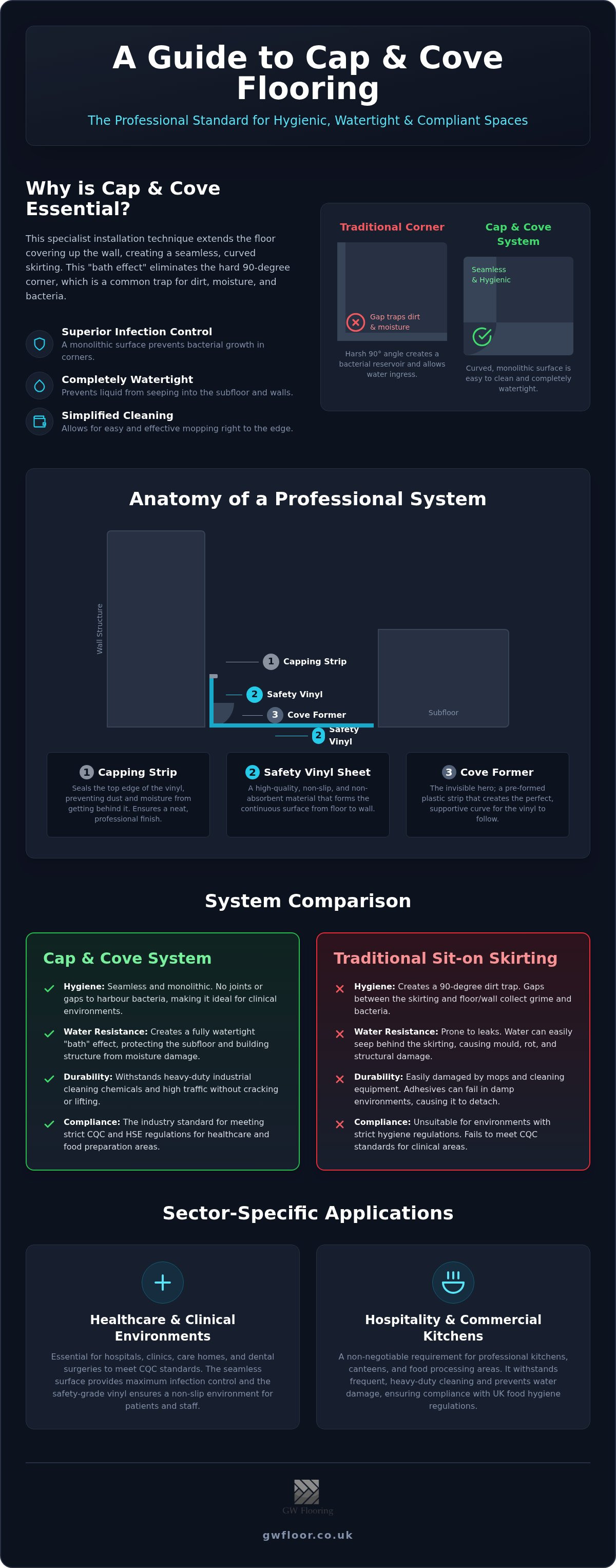
Cap and cove flooring isn't just a design choice; it's a technical necessity for high-hygiene areas. Essentially, it's a specialist installation where the floor covering continues up the wall to form a seamless skirting. This creates what we call the "bath" effect. By curving the vinyl upwards, we eliminate the harsh 90-degree corner where dirt usually hides. For anyone installing wet room flooring Essex, this monolithic surface is the gold standard because it prevents liquid ingress entirely.
Standard skirting boards might look fine in a living room, but they fail miserably in clinical or commercial environments. Standard joints leave gaps. These gaps allow moisture to seep behind the wall, leading to structural rot or mould growth. In contrast, cap and cove systems provide superior infection control and simplify your cleaning routine. You can mop right up to the wall without worrying about water escaping. Whilst many institutional settings traditionally used Vinyl Composition Tile (VCT) for its durability, modern safety vinyl combined with coving offers a superior, watertight finish that protects the building fabric.
Regulatory Compliance: Meeting CQC and HSE Standards
If you run an Essex clinic, you'll know that Care Quality Commission (CQC) inspections are rigorous. They look for surfaces that are easy to disinfect and free from bacterial reservoirs, a priority for any medical space including specialist clinics like Footfall Podiatry. Cap and cove flooring is the 2026 industry standard for clinical environments. Beyond hygiene, the Health and Safety Executive (HSE) mandates strict rules for slip resistance and trip hazard prevention. Because these systems use safety-grade vinyl, they provide a consistent, non-slip surface that protects both staff and patients. This ensures your facility remains compliant whilst providing a safe environment for everyone.
The Anatomy of a Professional Cap and Cove System
A successful installation of wet room flooring Essex relies on three technical pillars working in harmony. It isn't just about the surface vinyl. You need a high-quality safety sheet, a cove former, and a capping strip. These components must be perfectly compatible to ensure the watertight integrity of the space. We often use safety vinyl from leading manufacturers like Altro or Polyflor because their materials are designed to flex without compromising their slip-resistant properties.
This technical assembly is the primary way we help local businesses comply with UK food hygiene regulations for flooring. These laws demand surfaces that are non-absorbent and easy to disinfect. Without the right internal anatomy, your floor is merely a covering. With it, the floor becomes a protective shield for your building fabric. It ensures that every corner is rounded, making it impossible for grime to hide from your cleaning team.
The Cove Former: Structuring the Curve
The cove former is the invisible hero of the system. It sits at the junction where the wall meets the floor. We typically use a 20mm radius former for standard wet rooms, but a 38mm version is often preferred for heavy-duty commercial environments. Its job is to provide a solid radius that supports the vinyl as it curves upwards. Without this support, the vinyl would be forced into a sharp 90-degree angle. This would eventually cause the material to snap or crack, leading to leaks. We always use high-grade contact adhesive to ensure a permanent bond that won't lift, even in high-traffic areas.
Capping Strips and Internal Mitring
At the top of the vertical vinyl section, we install a capping strip to create a neat, dust-free finish. You can choose between flexible capping seals that hug the wall or rigid PVC strips for a more industrial look. This strip is vital because it prevents water and bacteria from seeping behind the vinyl edge. The mark of a seasoned craftsman is found in the mitring. Precise internal and external mitre cuts ensure the system looks as professional as it performs. If you're planning a renovation, our showroom to you service brings these technical samples directly to your doorstep so you can see the components in person. This allows us to plan the perfect foundational setup for your specific Essex site.
Cap and Cove vs. Sit-on Skirting: A Practical Comparison
Choosing the right finish for your walls is just as important as selecting the vinyl itself. Whilst sit-on skirting is a common choice for many standard installations, it often falls short in the demanding environments of Essex offices or healthcare facilities. The primary difference lies in the installation complexity. Sit-on skirting is a pre-fabricated PVC profile glued over the top of the floor covering. In contrast, cap and cove is a site-formed system where the floor itself becomes the skirting. This creates a streamlined, modern appearance that looks integrated rather than added on.
Long-term value is where the two systems truly diverge. Cap and cove flooring is built to survive heavy-duty cleaning chemicals and constant moisture. Because the system is one continuous piece of material, there are no gaps for water to penetrate. This significantly reduces the need for resealing over time. If you're investing in wet room flooring Essex, you want a solution that stands up to the rigours of daily sanitisation without the edges lifting or the adhesive failing due to chemical exposure.
The Hygiene Divide: Why Coving Wins
The biggest drawback of sit-on skirting is the joint where the skirting meets the floor. These joints are notorious bacteria traps. Even with the best cleaning regime, grime and microbes can thrive amongst the small gaps and sealant lines. By choosing a coved system, we create a truly monolithic surface. When combined with professional hot-welding, the entire floor and skirting become a single, impenetrable unit. We often recommend this for high-footfall Rayleigh premises where infection control is a top priority; it's simply the most disciplined way to manage hygiene.
Cost vs. Performance for Essex Businesses
We understand that every project has a budget. Sit-on skirting can be a faster, tactical solution for low-moisture storage areas or dry corridors where hygiene isn't the primary concern. However, for any area exposed to liquids or clinical standards, the performance gap is too wide to ignore. This is why we are the preferred commercial safety flooring contractors Essex for businesses that value longevity. Whilst cap and cove requires more intensive subfloor preparation and higher technical skill, the return on investment comes through reduced maintenance and guaranteed compliance. A professional wet room flooring Essex installation should always prioritise the foundation to ensure the surface remains watertight for its entire lifespan.
The Professional Installation Process in Essex
Installing wet room flooring Essex projects requires a disciplined, multi-stage approach that prioritises the foundation. We don't just roll out vinyl; we engineer a watertight system. Our process begins with an in-depth subfloor assessment and hygrometer moisture testing. If the subfloor contains too much residual moisture, the adhesive will eventually fail. Once we're satisfied with the conditions, we move to the foundation work, followed by the precise installation of cove formers and capping strips. The vinyl is then meticulously scribed and fitted, finished with specialist hot-welding to ensure the entire room is impenetrable to liquids.
The technical steps we follow include:
- Comprehensive moisture testing to ensure subfloor integrity.
- Application of professional screed or marine-grade plyboarding.
- Fixing cove formers to create the necessary radius for the vinyl.
- Scribing safety vinyl with precise internal and external mitring.
- Sealing every join using high-temperature thermal welding.
The "Invisible Work": Subfloor Screeding and Prep
We firmly believe that foundational preparation is the requirement for a high-quality finished product. For the cove former to sit perfectly flush against the wall, the subfloor must be level. Our floor installation experts often encounter uneven concrete in older Essex warehouses or damp-prone subfloors in commercial kitchens. We resolve these issues using professional-grade smoothing compounds or marine-grade plyboarding for timber subfloors. This meticulous groundwork ensures that the vertical section of your vinyl won't buckle or pull away from the wall over time.
Hot-Welding: The Secret to a Seamless Finish
Hot-welding is the technical process that transforms individual sheets of vinyl into a single, monolithic surface. We use a high-temperature heat gun to melt a colour-matched welding rod into the grooved joins of the vinyl. This creates a bond that is 100% watertight, preventing subfloor rot and protecting the building fabric from hidden damage. Once the weld has cooled, it must be trimmed flush to the surface. A weld must be trimmed flush to eliminate trip hazards and dirt traps that could otherwise compromise the hygiene of your wet room. If you want a floor that stands up to heavy industrial cleaning, book a complimentary assessment with our Rayleigh-based team to discuss your specific project requirements.
Sector-Specific Applications for Cap and Cove Flooring
Different environments present unique challenges for floor surfaces. Whether we're working in a busy Rayleigh school or a high-end spa in Chelmsford, the goal is always a disciplined, compliant finish. Cap and cove is the standard choice because it adapts to these varied demands, providing a monolithic shield against bacteria and moisture. Whilst the technical pillars of the installation remain the same, the specific material choices vary to meet the rigorous standards of each industry.
Healthcare and Veterinary Clinics
In clinical settings, seamless floors aren't just a preference; they're a mandatory requirement for surgery and treatment rooms. These surfaces must resist damage from harsh clinical-grade disinfectants and heavy cleaning agents used multiple times a day. We understand the need for a sterile environment that stands up to the rigours of NHS or private practice standards. For those looking to refurbish an entire facility, we also work with professional carpet fitters Essex to provide comfortable, high-quality finishes for non-clinical waiting areas and staff offices. This ensures your entire premises reflects the same high standard of care.
Commercial Kitchens and Food Prep Areas
Safety is the absolute priority in any hospitality environment. We pair cap and cove with R11 or R12 slip-rated vinyl to manage the constant risk of grease and liquid spills. These floors must handle high-temperature spills and frequent industrial wash-downs without the adhesive lifting or the vinyl buckling. Our Rayleigh team is experienced in organising installations around your service hours to minimise business downtime. This is particularly vital for wet room flooring Essex projects in the hospitality sector, where every hour of closure impacts your bottom line. We take pride in delivering a frictionless process that gets your kitchen back in action quickly.
Education and Leisure Environments
In the education sector, we provide durable, easy-clean coving for school toilets, science labs, and changing rooms. These areas face heavy footfall and require a surface that won't degrade under constant scrubbing or chemical exposure. Similarly, for the leisure industry, we specialise in wet room flooring Essex solutions for gyms, boutique spas, and hydrotherapy pools. Creating a slip-resistant, watertight environment is essential for guest safety in these high-moisture zones. Our meticulous approach ensures that the foundational groundwork supports a surface that remains pristine and safe under the most demanding conditions, protecting both your visitors and your building fabric for years to come.
Secure Your Hygienic Future with Professional Installation
Achieving a completely watertight and CQC-compliant environment requires a disciplined approach to every layer of your installation. By choosing a seamless cap and cove system, you effectively eliminate bacterial reservoirs whilst protecting the structural integrity of your building fabric. We know that the longevity of your wet room flooring Essex depends entirely on the invisible work of subfloor preparation and the precision of the final thermal weld.
With over 20 years of industry experience based in Rayleigh, our family-run team prioritises integrity and meticulous craftsmanship in every project. We understand the pressure of meeting hygiene inspections and the importance of a floor that stands up to heavy industrial cleaning. We are here to act as your creative and technical partners, ensuring your vision is realised without the stress of traditional renovations. High-quality materials and foundational groundwork are the hallmarks of our service.
Take the first step toward a safer, more professional environment today. Book your free "showroom to you" assessment with GW Flooring today to see our specialist range in person. We look forward to helping you create a space you can take genuine pride in.
Frequently Asked Questions
Is cap and cove flooring more expensive than traditional skirting?
Cap and cove flooring generally involves a higher initial investment than traditional sit-on skirting due to the technical expertise and specialist components required. However, it provides significantly better value over time. By creating a completely watertight seal, you avoid the costs associated with subfloor rot and frequent resealing. It's a disciplined choice for any wet room flooring Essex project where durability and long-term hygiene are the primary objectives for the building owner.
Can cap and cove be installed on any type of subfloor?
We can install these systems on almost any subfloor, provided the foundational work is handled correctly. For concrete surfaces, we apply professional smoothing compounds to ensure a level finish. On timber floors, we use marine-grade plyboarding to create a stable base. This meticulous preparation is vital because the cove former requires a perfectly flat surface to sit flush against the wall and provide the necessary support for the vinyl curve.
What happens if the vinyl is not hot-welded in a coved system?
If the joins are not hot-welded, the floor is no longer a monolithic, watertight surface. Thermal welding is the only way to fuse the vinyl sheets into a single unit. Without this step, water and cleaning chemicals will eventually seep amongst the joints, leading to adhesive failure and bacterial growth. We always use colour-matched welding rods to ensure the finish is both aesthetically pleasing and technically secure against moisture ingress.
How long does a professional cap and cove installation typically take?
The duration of an installation depends on the room size and the amount of subfloor preparation needed. A typical commercial wet room flooring Essex project usually takes between one and two days. This timeframe allows us to conduct moisture testing, apply screed or plyboarding, and perform the specialist hot-welding. We prioritise doing the job right over doing it quickly, ensuring the foundational work is perfect before the final surface is laid.
Is cap and cove flooring suitable for domestic bathrooms in Essex?
Yes, it is becoming increasingly popular for domestic bathrooms and home wet rooms. Homeowners value the seamless, modern aesthetic and the peace of mind that comes with a truly waterproof floor. It's an ideal way to future-proof your home, providing a safe, non-slip surface that is incredibly easy to maintain. Our Rayleigh-based team applies the same clinical-grade standards to domestic projects as we do to our large-scale commercial contracts.
Do I need a specific type of vinyl for the cap and cove method?
The method requires flexible sheet vinyl specifically designed for coving. Traditional rigid tiles or thick luxury vinyl tiles (LVT) aren't suitable for curving up a wall. We typically use safety vinyl from reputable brands like Altro or Polyflor. These materials are engineered to maintain their slip-resistant properties even when flexed around a cove former, ensuring your floor remains safe and compliant with UK health and safety standards.
How do I clean and maintain a coved flooring system?
Cleaning a coved system is remarkably straightforward because there are no sharp 90-degree corners to trap grime. You can use standard neutral detergents and a mop or mechanical scrubber for larger areas. Because the surface is monolithic and watertight, you don't need to worry about moisture seeping into the walls during deep cleans. This simplified maintenance routine is one of the biggest benefits for busy Essex business managers and homeowners alike.
Can GW Flooring provide samples for my Essex business assessment?
Absolutely, we bring the showroom directly to your doorstep. Our Rayleigh-based experts carry an extensive range of safety vinyl samples, cove formers, and capping strips. This allows you to see how different colours and textures look in your actual environment. During this complimentary assessment, we also conduct a technical subfloor survey to ensure we plan the perfect foundational setup for your specific Essex premises and hygiene requirements.


