
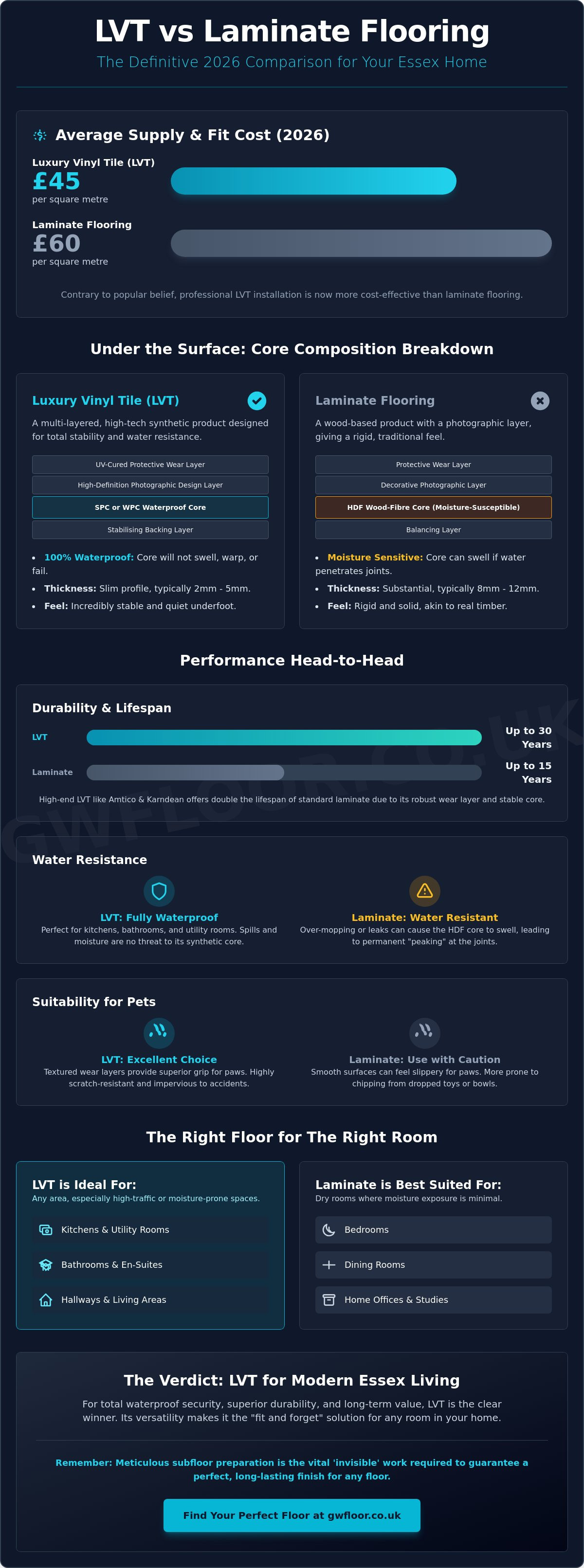
You might think laminate is the automatic budget-friendly choice for your Essex renovation, but in 2026, the average supply and fit cost for laminate has reached £60 per square metre, actually exceeding the £45 per square metre average for Luxury Vinyl Tile. We understand that choosing between lvt vs laminate feels like a minefield when you're trying to balance a beautiful wood aesthetic with the practicalities of muddy paws, spilled drinks, and the dread of floorboards lifting in a damp kitchen. It's a significant decision that impacts your home's comfort and long-term value for years to come.
In this guide, we provide the definitive comparison to help you choose a floor that offers total waterproof security and a quiet, warm surface underfoot. You'll discover why high-end brands like Amtico and Karndean are leading the way in durability, often lasting up to 30 years compared to the 15-year lifespan of standard laminate. We also pull back the curtain on "hidden" installation costs and explain why our mantra that "preparation is key" ensures your investment remains a true reflection of your style. Whether you're in Rayleigh or across the wider Essex area, we'll help you find the perfect fit for your space.
Key Takeaways
- Understand why LVT provides a completely waterproof solution for kitchens and bathrooms whilst laminate remains better suited for dry living areas.
- Compare the long-term performance of lvt vs laminate to see how specific wear layers protect your investment against scratches from pets and children.
- Learn why meticulous subfloor preparation is the vital "invisible" work required to prevent floor lifting and ensure a long-lasting, perfect finish.
- Discover which surface offers the best underfoot grip for pets and the most straightforward maintenance routine to keep your Essex home looking top-notch.
- Identify the specific rooms where modern rigid-core technology outperforms traditional boards to help you realise your unique design vision.
Understanding the Core Differences: What Are LVT and Laminate?
Choosing between lvt vs laminate often comes down to what is happening beneath the surface of your floor. While both options provide an exceptional aesthetic that mimics natural materials, their chemical and physical makeup couldn't be more different. We find that many Essex homeowners are surprised to learn that LVT is a high-tech PVC product, whereas laminate is essentially a dense wood-fibre board. This distinction is exactly why one thrives in a steamy bathroom whilst the other is better suited for a cosy lounge or bedroom.
By 2026, printing technology has advanced so far that even a seasoned craftsman has to look twice at the finished result. High-definition photographic layers now capture the exact grain of European oak or the cool, tactile texture of Italian slate. Whether you choose the waterproof security of LVT or the traditional warmth of laminate, you'll achieve a look that is a true reflection of your style without the maintenance headaches of real wood or stone.
The Structure of Luxury Vinyl Tiles
Luxury Vinyl Tiles are engineered using multiple layers of synthetic material to ensure maximum stability. To understand What is LVT, you have to look at its core, which is typically made from Stone Plastic Composite (SPC) or Wood Plastic Composite (WPC). These materials ensure the tile remains 100% waterproof and won't warp when the humidity in your kitchen rises. LVT is a synthetic, high-performance alternative to traditional vinyl.
Because LVT is relatively thin, usually ranging between 2mm and 5mm, it feels incredibly stable underfoot once we've applied a professional latex screed to the subfloor. This slim profile makes it perfect for modern homes where door clearances are tight. The top wear layer is a transparent coating that protects the design from scratches, making it a top-notch choice for busy households with pets or young children.
The Anatomy of Modern Laminate
Laminate takes a different approach by using a High-Density Fibreboard (HDF) core. This core is made from compressed wood fibres, which gives the floor a sturdy, rigid feel that many people associate with real timber. Modern laminate boards are typically 8mm to 12mm thick; this extra depth allows for a deep "click-lock" system that makes the boards feel very substantial underfoot.
However, because it contains real wood fibres, the core remains susceptible to moisture expansion. If water seeps into the joints of a standard laminate, the HDF can swell and cause the edges to lift. This is why we generally recommend laminate for low-moisture areas like bedrooms or dining rooms. While the 2026 "water-resistant" coatings have improved performance, they still don't offer the total watertight security that we see with premium LVT brands like Karndean or Amtico. For a reliable, long-lasting finish, the debate of lvt vs laminate usually ends with LVT being the superior choice for high-traffic or wet areas.
Performance Comparison: Durability, Water Resistance, and Comfort
When we discuss the choice between lvt vs laminate with our clients in Rayleigh, the conversation often shifts from aesthetic appeal to long-term survival. A comprehensive comparison of LVT and laminate reveals that while both materials are engineered for the rigours of modern life, their structural response to daily stress is vastly different. LVT is designed to be a "fit and forget" solution for high-traffic areas, whereas laminate requires a bit more mindfulness, particularly regarding spills and heavy impact.
Durability isn't just about resisting scratches; it's about how the floor handles the specific environment of an Essex home. For households with pets amongst the family, LVT often takes the lead. The top-notch wear layers on brands like Karndean are specifically textured to provide better grip for paws whilst remaining impervious to claw marks. Laminate, while hard-wearing, can sometimes feel slippery for older dogs and is more prone to chipping if a heavy object is dropped from a height.
Moisture Behaviour in the Home
The most significant performance gap lies in water resistance. We've seen countless "blown joints" in laminate floors across Essex where a small leak or even over-mopping has caused the HDF core to swell. This "peaking" at the edges is permanent and usually requires a full floor replacement. In contrast, LVT can be fully submerged in water without losing its structural integrity. This makes it the only viable choice for bathrooms, utility rooms, and kitchens where moisture is a constant factor.
While choosing waterproof flooring is a sensible precaution, it is also essential to ensure your home's plumbing is well-maintained to prevent leaks from occurring. For readers who may need professional assistance with residential repairs, you can discover Viktor's Plumbing Services for reliable support in the Norwich area.
In older properties, particularly those without a modern damp-proof course, we always insist that "preparation is key." We often apply a liquid DPM (Damp Proof Membrane) to the subfloor before laying LVT. This professional step creates a watertight barrier that protects your investment from rising damp, a level of security you simply don't get with a floating laminate installation. If you're unsure about your subfloor's condition, we can help you organise a professional site survey to check moisture levels.
Acoustics and Underfoot Comfort
The tactile experience of walking across your home matters. On a cold Rayleigh morning, LVT feels noticeably warmer underfoot because it's a better thermal conductor. When paired with modern underfloor heating, LVT transfers heat more efficiently than the thicker, more insulative boards of a laminate floor. There's also the question of sound. Laminate is a "floating" floor, which can sometimes produce a hollow, "clicky" sound when walked on in heels or by pets. Because we typically glue LVT directly to a prepared subfloor, it offers a solid, quiet, and premium feel that significantly reduces footfall noise between rooms.
The Critical Role of Installation and Subfloor Preparation
We often tell our clients that the most important part of a new floor is the part they'll never actually see. At GW Flooring, our core mantra is that "preparation is key to a long-lasting perfect floor," and this principle dictates every project we undertake across Essex. When weighing up lvt vs laminate, the installation process is where the two products diverge most sharply. Laminate is typically installed as a "floating floor," meaning the boards click together over an underlay without being fixed to the ground. This method is slightly more forgiving of minor subfloor flaws, as the rigid boards can bridge very small dips or imperfections.
In contrast, glue-down Luxury Vinyl Tiles require a "table-top" smooth surface. Because LVT is thinner and more flexible than laminate, any tiny pebble, ridge, or uneven patch in the subfloor will eventually "telegraph" through to the surface. This appears as a visible bump or dent that ruins the aesthetic of your room. This LVT vs. Laminate Flooring Comparison highlights how installation complexity often influences the final choice for homeowners. For a truly professional finish, we recommend reading The Essential Guide to Professional Floor Installation in Rayleigh and Essex to understand the specific requirements for your property.
The Screeding and Plywood Process
The type of subfloor in your home determines our technical approach. If you have a concrete base, we typically apply a high-quality latex screed to create a perfectly level, glass-smooth finish. For homes with timber joists and floorboards, we install a layer of flooring-grade plywood to provide a stable, flat foundation that won't move or creak. These professional steps prevent tiles from lifting or shifting over time. LVT is only as good as the surface it sits upon.
DIY vs Professional Fitting
While some homeowners are tempted by a DIY approach, the technical risks often outweigh the initial savings. Correct adhesive choice and precise expansion gaps are critical; if these are calculated incorrectly, your floor could buckle or gap as temperatures shift. Professional fitters are also essential for complex designs like herringbone or bespoke border work, which require meticulous planning and expert cutting. Our "showroom to you" service ensures you see samples in your home's natural lighting, eliminating the risk of choosing the wrong shade in a shop. With 21 years of experience, we provide a safe pair of hands for your renovation, ensuring the final result is an amazing transformation of your living space.
Lifestyle Factors: Maintenance, Pets, and High-Traffic Areas
Living with your new floor is where the real-world value of your investment becomes clear. When comparing lvt vs laminate, we look at how each surface stands up to the chaotic rhythm of a busy Essex household. While both options are designed for durability, the way you maintain them and how they respond to daily wear differs significantly. For many of our clients in Rayleigh, the decision often hinges on which floor makes their life easier on a Tuesday morning when the dog runs in with muddy paws or a coffee cup hits the deck.
Cleaning routines are straightforward for both, but LVT offers a distinct advantage for deep cleaning. Because it's 100% waterproof, you can use a damp microfibre mop and a pH-neutral cleaner without any fear of the boards swelling. Some online forums suggest laminate is easier to clean, but we've found that modern LVT is actually superior for hygiene because it handles wet mopping far better. Laminate requires a much drier touch; too much moisture during cleaning can lead to the "peaking" we mentioned earlier.
For pet owners, LVT is the top-notch choice. The textured surface of premium brands like Karndean provides much-needed grip for dogs, preventing them from sliding as they might on a smoother laminate. The thick wear layer also resists scratches from claws exceptionally well. Furthermore, if a section of your floor does suffer significant damage, glue-down LVT is remarkably easy to repair. We can simply heat and remove a single damaged tile and replace it with a new one. With laminate, you'd likely need to unclick the entire floor from the nearest wall to reach the damaged board.
The Busy Household Test
Spills are an inevitable part of life, especially in the kitchen. Choosing LVT gives you total peace of mind because even a major leak won't ruin the floor. When it comes to heavy furniture, we always recommend using felt pads under dining tables and sofas to prevent indents. For a more detailed look at how different materials perform across the county, you can read our guide on Professional Flooring Solutions in Essex: The Complete Guide for 2026.
Longevity and Warranty
The lifespan of these materials is a key factor in their overall value. High-quality LVT typically lasts between 15 and 25 years, whereas premium laminate usually has a shorter lifespan of 10 to 15 years. It's also important to understand that manufacturer warranties are often quite specific. Most premium brands, such as Amtico, require professional installation as a condition of their guarantee. This is because they know that "preparation is key" and only a seasoned craftsman can ensure the subfloor is perfect. If you're ready to see how these materials look in your own home, you can book a free no-obligation quote today.
Making the Choice: Which Flooring Suits Your Specific Room?
Choosing the right material for each room ensures your home remains both functional and beautiful for decades. While the debate of lvt vs laminate often focuses on technical specs, the real test happens in the specific environment of your living space. We've spent 21 years helping Essex homeowners navigate these choices, and we've found that a "one size fits all" approach rarely works. Each area of your home has unique demands, from the steam of a morning shower to the heavy footfall in a busy hallway.
In kitchens and bathrooms, the choice is clear. While some retailers suggest that modern laminate is "fine if you're careful," we know that an accidental dishwasher leak or a splashed bath is almost inevitable. For these high-moisture zones, the case for LVT flooring installation Essex is undeniable. It provides a completely watertight surface that protects your subfloor from structural damage. In hallways and lounges, you need to balance aesthetic warmth with high-traffic durability. LVT excels here by resisting the scuffs of daily life whilst remaining quiet and warm underfoot. For bedrooms, laminate or even luxury carpets can be a more cost-effective choice, as these rooms face less moisture and lower traffic levels.
Budget vs Value
Initial costs can be deceptive when comparing lvt vs laminate. Laminate often has a lower upfront material cost, but LVT frequently wins on "cost per year" because of its 30-year potential lifespan. We believe in providing a transparent experience, which is why our "showroom to you" service is so popular in Rayleigh. We bring the samples to your home, allowing you to see how different textures and colours look in your specific lighting. This personalised approach ensures you find the best value for your budget without any guesswork. Investing in high-quality flooring also significantly boosts your property value in the local Essex market, as buyers increasingly look for durable, low-maintenance finishes.
Final Recommendations
Before you make your final decision, we suggest asking yourself these five key questions to ensure the floor is a true reflection of your style and needs:
- Does the room face frequent moisture or high humidity?
- Will pets or young children be using the space daily?
- Is the subfloor already perfectly level, or will it require a latex screed?
- Are you planning to install or use underfloor heating?
- How many years do you want the floor to last before replacement?
Seeing samples in a warehouse rarely gives you the full picture. We invite you to contact us at GW Flooring for a free, no-obligation quote. We'll visit your home, assess your subfloor, and help you realise your vision with a professional, meticulous installation that stands the test of time. Call us now to book your home visit and take the first step toward an amazing home transformation.
Transform Your Essex Home with the Right Foundation
Selecting between lvt vs laminate is about matching a product's performance to your family's daily lifestyle. You now understand that while laminate offers a traditional feel for low-traffic rooms, LVT provides the total waterproof security needed for modern kitchens and bathrooms. Our family-run team has spent over 20 years perfecting the art of installation across Rayleigh and the wider Essex area. We know that a floor is only as good as the surface beneath it; that's why we never skip the meticulous subfloor preparation that high-end brands like Amtico, Karndean, and Invictus require.
We take the stress out of your renovation by bringing the samples directly to your doorstep. This ensures your chosen design and colour is a true reflection of your style in your home's unique light. You don't have to navigate these technical choices alone. Our seasoned craftsmen are ready to help you realise your vision with a seamless, professional experience from start to finish. We pride ourselves on being a safe pair of hands for every unique project.
Book your free "showroom to you" home visit and get a no-obligation quote today to begin your journey toward an exceptional new floor. We look forward to helping you create a space you'll be proud of for decades.
Frequently Asked Questions
Is LVT more expensive than laminate to install?
In 2026, LVT is often more affordable to install than laminate, with average supply and fit costs at £45 per square metre compared to laminate's £60 per square metre. While the labour for LVT can be slightly higher due to the meticulous subfloor preparation required, the overall investment is often lower. We find that the long term value of LVT is superior because it typically lasts up to 30 years.
Can you lay LVT over existing laminate flooring?
No, you cannot lay LVT directly over existing laminate flooring because laminate is a floating floor that expands and contracts. For a successful installation, we must remove the old boards and prepare the subfloor properly. Our team always ensures the base is solid and level; usually by applying a latex screed or plywood; to prevent the tiles from shifting or lifting over time.
Which is better for dogs, LVT or laminate?
LVT is generally the better choice for households with dogs because it offers superior scratch resistance and a more textured, slip resistant surface. The comparison of lvt vs laminate shows that dogs often struggle with the "clicky" sound and slippery finish of laminate boards. LVT provides a quieter, warmer surface that is easier on their joints whilst resisting damage from claws and accidental spills.
Is LVT actually waterproof or just water-resistant?
LVT is 100% waterproof, whereas most laminate flooring is only water resistant. This means LVT can handle standing water and high humidity in bathrooms or kitchens without warping or losing structural integrity. Laminate contains a wood based HDF core that will swell if moisture penetrates the joints. For total peace of mind in wet areas, LVT is the professional recommendation for a long lasting, watertight finish.
Do I need underlay for LVT if I am using the glue-down method?
You do not use a traditional foam underlay for glue down LVT because the tiles are bonded directly to a prepared subfloor. Instead, the "underlay" is essentially the work we do to the base, such as installing a 6mm plywood layer or a smoothing compound. This ensures the tiles remain perfectly flat and secure. Using a soft underlay would cause the adhesive bond to fail and the tiles to move.
How long does a professional floor installation take for a standard room?
A professional installation for a standard 15 square metre room typically takes two days to complete. The first day is dedicated to the vital subfloor preparation, such as applying a latex screed or fitting plywood. Once the preparation has dried or settled, the second day is spent precisely laying the tiles or boards. Larger or more complex patterns, like a herringbone layout, can extend this timeline to three days.
Can laminate flooring be used with underfloor heating?
Yes, modern laminate flooring is compatible with underfloor heating, provided the system does not exceed 27 degrees Celsius. However, LVT is often the preferred choice for these systems because it is thinner and transfers heat more efficiently. When choosing between lvt vs laminate for a heated floor, consider that LVT will reach the desired temperature faster and provide a more consistent warmth across the room's surface.
Why is my laminate floor clicking when I walk on it?
Your laminate floor is likely clicking because the subfloor was not perfectly level before installation. This sound occurs when the boards move slightly and rub against each other or the underlay as you walk over them. It's a common issue when the rule that "preparation is key" has been ignored. To fix it, the floor usually needs to be lifted so the subfloor can be levelled with a smoothing compound.


